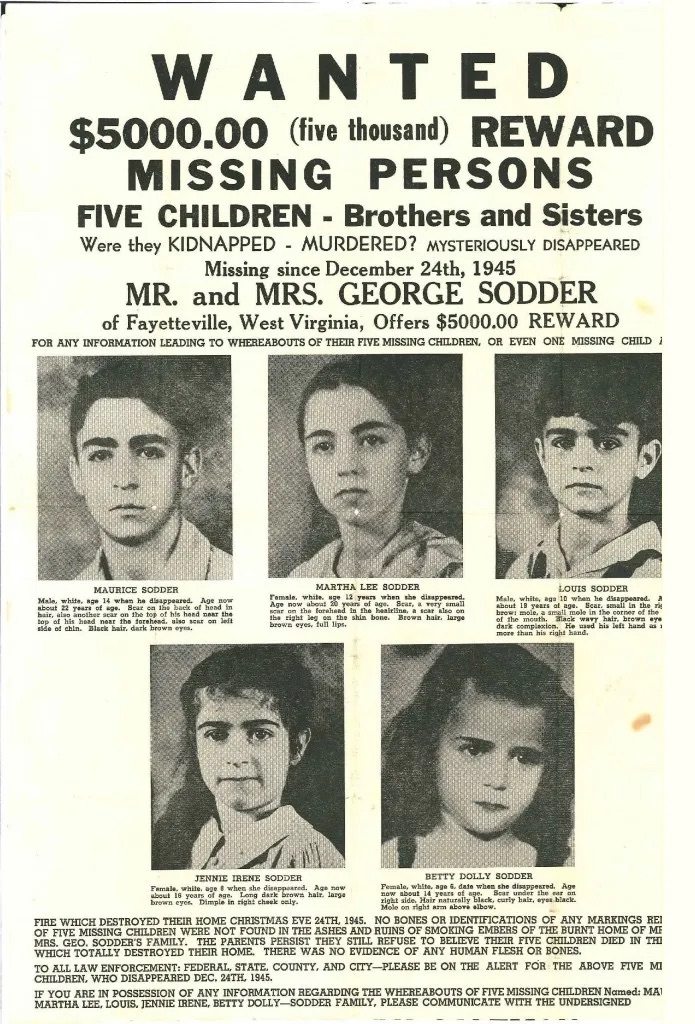
Some mysteries refuse to fade—not because of what is known, but because of what never made sense in the first place. The disappearance of the Sodder children is one of the most haunting unsolved cases in American history, a story marked by unanswered questions, alleged cover-ups, and a family that never stopped searching for the truth.
Who Was the Sodder Family?
Before they became the center of one of America’s most enduring mysteries, the Sodders were a working-class immigrant family living a quiet life in rural West Virginia—far removed from the notoriety that would later define their name.
George Sodder was born in Sardinia, Italy, in 1895 and immigrated to the United States as a teenager. After arriving in America, he anglicized his name and worked a variety of labor-intensive jobs before eventually establishing himself as a successful truck driver and business owner. By the 1940s, George was known locally as hardworking, outspoken, and fiercely independent.
Jennie Sodder, also born in Italy, immigrated to the United States as a child. She was described by family members as deeply devoted to her children and traditional in her values. Jennie managed the household and served as the emotional center of the family, maintaining strong ties to her Italian heritage.
The Sodders lived in Fayetteville, where they raised ten children in a modest but stable home. Despite being immigrants in a rural Appalachian town, the family was financially secure and socially visible. George’s business provided a steady income, allowing the family to live comfortably by local standards.
However, George was also known for his strong political opinions. He was openly critical of Benito Mussolini and Italian fascism—a stance that reportedly caused tension with some members of the local Italian-American community. While there is no definitive evidence linking these views to what happened later, they would become a central element in the family’s suspicions after the fire.
By all accounts, the Sodder children were healthy, active, and closely bonded. Family photographs show a lively household—birthday parties, school portraits, and group photos that now serve as haunting reminders of a life interrupted.
When the fire occurred on Christmas Eve 1945, it did more than destroy a house. It shattered a family’s sense of safety and trust in the systems meant to protect them. From that moment on, the Sodders were no longer just parents and children—they became lifelong searchers for answers in a case that would never fully let them go.
The Fire on Christmas Eve
Just after 1:00 a.m. on December 25, 1945, a fire broke out in the Sodder home. George and Jennie managed to escape with five of their children, but five were unaccounted for:
- Maurice Sodder (14)
- Martha Sodder (12)
- Louis Sodder (9)
- Jennie Sodder Jr. (8)
- Betty Sodder (5)
George attempted multiple rescues—trying to use a ladder and attempting to drive his truck closer to the house—but nothing worked. By the time help arrived, the house had collapsed into ashes.
Authorities quickly concluded that the missing children had died in the fire. The Sodders didn’t believe it.
No Remains, No Answers
In the aftermath, investigators failed to recover any physical remains belonging to the five children. No bones. No teeth. No skull fragments.
This alone raised serious doubts. Fire experts—even at the time—acknowledged that residential fires rarely reach temperatures sufficient to completely destroy human remains.
George Sodder, who had experience working with machinery and construction, found the official explanation implausible.
To prove his point, the family later conducted informal tests by burning animal remains on their property. Bones were always left behind.
Yet the fire was ruled an accident, and the case was effectively closed.
Disturbing Details and Inconsistencies
As the weeks passed, a series of inconsistencies began to undermine the official explanation. The Sodders discovered that their phone line had been cut prior to the fire, and the ladder normally kept against the house was missing. George’s truck—which he intended to use to reach the house—would not start, despite being fully operational the day before. Despite these irregularities, the coroner declared the missing children dead without ever conducting a formal inspection of the scene. Additional witness accounts further complicated the narrative, including reports of someone throwing a burning object onto the roof and a woman who claimed she saw children matching the Sodders’ descriptions inside a car near the home during the fire. In the days that followed, the family also reported receiving threatening phone calls and encountering individuals who discouraged them from continuing their search for answers.
The Abduction Theory
Over time, the Sodders began to believe the children had been abducted, not killed.
Due to George’s vocal dislike of Benito Mussolini, the family suspected the fire may have been staged as a diversion, allowing the children to be taken as a punishment. No direct evidence ever confirmed this theory, but the family believed the motive aligned with the hostility George had previously encountered.
In the years that followed, the Sodders pursued leads across the country. Reports surfaced of children matching the Sodders’ descriptions being seen in Florida and Texas, while another lead pointed to a Catholic convent that claimed children of similar appearance had been placed in its care. Perhaps the most haunting clue arrived in the 1960s, when the family received a photograph of a young man believed to resemble an adult Louis Sodder. The image was signed, “Louis Sodder.”
No lead was ever conclusively proven—but none were entirely disproven either.
A Family’s Lifelong Search
Jennie Sodder never accepted the official explanation. She reportedly wore black for the rest of her life, mourning children she believed were still alive. The family erected a massive billboard along a West Virginia highway displaying the children’s faces and offering a reward for information. It stood for decades.
Despite private investigations, FBI involvement, and public pressure, the case was never reopened in a meaningful way. Official records were incomplete, evidence was mishandled, and early investigative decisions permanently shaped the narrative.
Why the Case Still Matters
The Sodder children mystery endures because it exists in a space between tragedy and possibility. If the children died, the lack of physical evidence defies forensic logic. If they lived, then someone orchestrated one of the most chilling kidnappings in U.S. history—and got away with it.
At its core, this is not just a mystery about missing children. It is a story about grief, mistrust in authority, and a family’s refusal to surrender to an explanation that never felt true.
Nearly 80 years later, the question remains:
What really happened to the Sodder children?
Where the Case Stands Today
The Sodder children’s disappearance remains officially unsolved.
While authorities continue to list the children as deceased due to the fire, the case is frequently cited by researchers and fire experts as deeply flawed. The lack of human remains, early investigative failures, and dismissed witness statements prevent definitive closure.
No verified DNA evidence exists. No confirmed sightings were ever substantiated. No suspects were charged.
Today, the case endures through the work of independent investigators and historians, as well as ongoing true crime research and documentary coverage. Public fascination with missing persons cases—particularly those involving alleged investigative failures or cover-ups—has kept the Sodder children’s disappearance in the public consciousness for decades.
At its core, the Sodder case represents more than a mystery—it is a cautionary tale about institutional certainty in the absence of proof, and a family’s lifelong refusal to accept an answer that never aligned with the evidence.
Five children vanished on Christmas morning. The truth vanished with them.
References
Hopkins, A. D. F. (2013). Christmas Eve tragedy. Charleston Gazette-Mail. https://www.wvgazettemail.com/life/christmas-eve-tragedy/article_12d6ec57-63a7-5902-b3c7-c85cd6b3bfff.html
Horn, S. (2005). Mystery of Missing Children Haunts W.Va. Town. NPR. https://www.npr.org/2005/12/23/5067563/mystery-of-missing-children-haunts-w-va-town
Kahler, A. (2024). What Happened to the Sodder Children, the Siblings Who Went up in Smoke in a West Virginia House Fire? (M. Solly, Ed.). Smithsonian Magazine. https://www.smithsonianmag.com/history/what-happened-sodder-children-siblings-who-went-up-in-smoke-west-virginia-house-fire-172429802/
Newton, M. (2009). The Encyclopedia of Unsolved Crimes. Infobase Publishing.
Stein, L., & Armitage, R. (2023). The Sodders thought they lost their children in a house fire. But they found only mystery in the ashes. ABC News. https://www.abc.net.au/news/2023-12-25/the-mystery-of-the-vanished-sodder-children/103245390
Leave a Reply