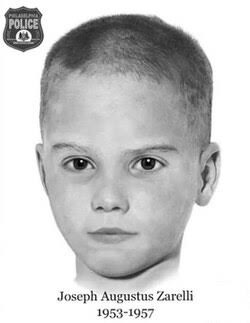
Few cases in American criminal history have carried the same haunting anonymity as the case long known as the “Boy in the Box,” later called “America’s Unknown Child.” Discovered in Philadelphia in 1957, the unidentified victim became one of the nation’s most enduring mysteries—highlighting both the vulnerability of children and the limitations of mid-twentieth-century investigative technology. For decades, investigators searched for the child’s identity and the person responsible for his death. Advances in forensic genealogy finally restored his name in 2022, but the case continues to raise profound questions about abuse, secrecy, and justice delayed.
Victim Profile
Case FileLife Context
Joseph Augustus Zarelli was born in 1953 in Philadelphia, Pennsylvania. Following his death, he remained unidentified for decades and became widely known as “The Boy in the Box” or “America’s Unknown Child.” His body was discovered on February 25, 1957, in a wooded area in the Fox Chase section of Philadelphia. The circumstances of his life prior to his death remain only partially understood due to limited surviving records and the absence of contemporaneous missing person reports.
Structural Vulnerabilities
Available evidence suggests that Joseph may have experienced neglect or abuse prior to his death. Investigators noted signs of malnourishment and physical trauma when his body was discovered. Cases involving very young victims often present investigative challenges because children may have limited contact with institutions such as schools or medical systems that might otherwise create documentation of their existence.
Public Framing
For decades, media coverage focused on the mystery surrounding the unidentified child rather than on the child himself. The case became widely known through the label “Boy in the Box,” a name derived from the cardboard bassinet box in which the victim’s body was found. While the phrase helped publicize the investigation, it also reduced the child’s identity to the circumstances of his discovery rather than recognizing him as an individual.
Why Centering the Victim Matters
Identifying Joseph Augustus Zarelli in 2022 through forensic genealogy restored a name to a child who had been unknown for more than six decades. Focusing on the victim shifts attention away from the mystery of the crime and back to the life that was lost.
Discovery of the Child
On February 25, 1957, a young boy’s body was discovered in a wooded lot on Susquehanna Road in the Fox Chase section of Philadelphia, Pennsylvania. The victim had been placed inside a cardboard box originally used to ship a baby bassinet. A college student made the discovery; disturbed by what he saw, he left and contacted the police the following day.
Investigators determined the victim was a boy between four and six years old. He was small for his age, malnourished, and showed signs that suggested long-term neglect. His body was naked but wrapped in a blanket inside the box. Bruises covered his body, and his hair appeared to have been recently cut, possibly after death. The medical examiner ruled the cause of death a homicide. His body showed numerous bruises and injuries in different stages of healing, suggesting prolonged physical abuse. However, investigators were unable to determine a precise medical cause of death.
The brutality of the crime—and the lack of any identifying information—shocked the public and triggered one of the largest homicide investigations in Philadelphia’s history.
Early Investigation
Philadelphia police launched an extensive effort to identify the child. Photographs of the boy’s face were widely distributed in newspapers across the country. Investigators circulated thousands of flyers, interviewed residents throughout the region, and examined missing-children reports in the hope of finding a match.
Because the boy had been found in a bassinet box, detectives attempted to trace its origins. The box was linked to a local J.C. Penney store, but the item had been sold in such large numbers that identifying the purchaser proved impossible. The blanket found with the boy was traced to a manufacturing batch sold across multiple states, offering little investigative value.
Authorities also investigated nearby foster homes, hospitals, orphanages, and adoption agencies. Hundreds of leads poured in from members of the public who believed they recognized the child, but none produced a confirmed identification.
Despite the intense effort, the investigation stalled. Without knowing the child’s identity, investigators had little ability to determine where he had lived or who might have harmed him.
“America’s Unknown Child”
Because no one came forward to claim the victim, the boy became known nationwide as “The Boy in the Box.” Police and the media later began referring to him as “America’s Unknown Child.” The name reflected both the tragedy of his death and the disturbing reality that no one appeared to know—or admit—who he was.
The child was buried in Potter’s Field in Parkwood not long after the discovery. He was then moved to Ivy Hill Cemetery in 1998. His grave became a place of remembrance for investigators and members of the public who felt a deep connection to the unidentified victim. For decades, detectives continued to reopen the case, hoping new evidence might finally reveal the boy’s identity.
Over the years, several theories emerged. Some investigators believed the child had died as a result of severe abuse within a family household. Others explored whether he might have been hidden from public records—perhaps never enrolled in school or reported missing. Without definitive evidence, however, these theories remained speculative.
The “Martha” Claim
One of the most widely discussed theories emerged in 2002 when a woman known publicly as “Martha” came forward with a disturbing account. She claimed that her mother had purchased a young boy from his parents and subjected him to constant abuse inside their home.
According to Martha, the child was killed during a violent episode after vomiting up his dinner. She alleged that her mother later disposed of the body in the wooded area where the boy was eventually discovered.
Investigators examined the claim closely, and while some details appeared consistent with known evidence, other aspects could not be corroborated. Ultimately, the information was considered insufficient to confirm the boy’s identity or solve the case.
Advances in Forensic Genealogy
For decades, the case remained one of the most well-known unsolved child homicides in the United States. Advances in forensic science—specifically, forensic genetic genealogy—eventually provided investigators with a new path forward.
In 1998, authorities exhumed the child’s remains to obtain DNA samples from a tooth. The body was exhumed again in 2019 to retrieve additional DNA samples. Although early DNA testing was limited, investigators preserved the genetic material in the hope that future technological advances would eventually enable identification.
Years later, improved DNA sequencing techniques allowed forensic scientists to generate a more detailed genetic profile. Investigators worked with forensic genealogists to compare the child’s DNA with profiles in public genealogy databases.
Rather than producing a direct match, the analysis revealed distant relatives who shared small segments of DNA with the unidentified child. Genealogists began constructing extensive family trees using these genetic connections, historical records, and demographic data. By tracking relationships across multiple generations, investigators gradually narrowed the pool of possible identities.
Through this process, genealogists identified both maternal and paternal family lines connected to the child. Further genealogical research and confirmatory DNA testing enabled investigators to determine that the boy was Joseph Augustus Zarelli, who was born in 1953 in Philadelphia.
In December 2022, Philadelphia police publicly announced the identification, restoring a name to a child who had remained unknown for more than sixty years.
Although identifying Joseph marked a major breakthrough, significant questions remain. While genealogical research revealed his biological family connections, it did not fully clarify the circumstances of his life or the events that led to his death. As a result, the homicide investigation continues.
Why the Case Remains Unresolved—and Why It Still Matters
The identification of Joseph Augustus Zarelli in 2022 restored a name to a child who had been unknown for more than sixty years. Yet identifying the victim does not automatically reveal the circumstances of their death. In many historic cases, the passage of time complicates efforts to determine responsibility, especially when key witnesses, records, or physical evidence no longer exist.
Investigators have acknowledged that much of Joseph’s early life remains unclear. Although genetic genealogy identified his biological family connections, public records offer little information about where he lived or who cared for him in the months before his death. Because Joseph was never formally reported missing, there were no contemporaneous investigations into his disappearance that might have preserved additional documentation.
The passage of more than six decades also presents practical investigative challenges. Potential witnesses may have died, memories fade over time, and physical evidence collected in the 1950s may no longer be available for modern testing. Cases involving very young victims can be especially difficult to reconstruct when a child had limited contact with institutions such as schools, medical providers, or social services that might otherwise create a public record of their existence.
Despite these challenges, the case continues to hold significant meaning for the criminal justice system. Joseph’s identification demonstrates the extraordinary impact of advances in forensic science, particularly the use of genetic genealogy in cold case investigations. Techniques that did not exist in 1957 ultimately made it possible to restore the identity of a child who had remained nameless for generations.
The case also highlights broader concerns about hidden abuse and vulnerable victims. Children who live in isolated or unstable environments may have few external connections that can recognize danger or report their disappearance. Joseph’s story serves as a reminder that some victims can vanish from public awareness unless institutions and communities remain vigilant.
Nearly seventy years after his death, Joseph Augustus Zarelli is no longer remembered only as the “Boy in the Box.” While the circumstances of his death remain unsolved, restoring his name represents an important step toward dignity, recognition, and the continued pursuit of the truth.
Legacy of the Case
Although the person or persons responsible for Joseph’s death have not been identified, the case continues to influence investigative practices. Cold case units increasingly rely on forensic genealogy, advanced DNA analysis, and interdisciplinary collaboration to revisit cases once considered unsolvable.
Joseph’s story also remains a powerful symbol of collective responsibility. For decades, strangers placed flowers and toys at the grave of “America’s Unknown Child,” determined that the boy would not be forgotten.
Now that his name is known, investigators and the public alike hope the truth about his death will one day come to light.
References
A&E Television Networks. (2025, September 18). How authorities identified the “Boy in the Box” after 65 years. Retrieved from https://www.aetv.com/articles/how-authorities-identified-the-boy-in-the-box-after-65-years
Carta Ramírez, N. (2023). The Implementation of Forensic Genetic Genealogy and Ethics.
Gehrke, C. (2024). An Analysis of True Crime’s Treatment of Murder Victims. Journal of Victimology and Victim Justice. https://doi.org/10.1177/25166069241245772
Greytak, E. M., Moore, C., & Armentrout, S. L. (2019). Genetic genealogy for cold case and active investigations. Forensic Science International, 299, 103–113. https://doi.org/10.1016/j.forsciint.2019.03.039
Leave a Reply