On the evening of September 13, 2016, Nisa Mickens and Kayla Cuevas were walking through their neighborhood in Brentwood, New York. They were fifteen and sixteen years old, lifelong friends, students at Brentwood High School. A car had been following them. The men inside—members of an MS-13 clique called the Sailors Locos Salvatruchas Westside—had been looking for Kayla specifically. She had been involved in a dispute with gang associates at school. That night, the dispute ended with a machete and a baseball bat. Nisa’s body was found on Stahley Street that evening. Kayla was discovered the following day behind a nearby house.
Few criminal organizations have become as recognizable in the United States as Mara Salvatrucha. The name has appeared in political speeches, immigration debates, law enforcement briefings, documentaries, and sensational headlines. Images of tattooed members and stories of brutal murders have helped create an almost mythical reputation—one that often blurs the line between reality and fear.
But what exactly is MS-13? How did it begin? And why has it become one of the most discussed criminal organizations in North America? Understanding the gang requires setting aside the rhetoric and examining the social conditions, violence, and policy failures that contributed to its rise—and being honest about which of those failures were American-made.
Unlike many of the cases covered on Crime Central, MS-13 is not a single crime or investigation. It is an organization whose history intersects with immigration policy, civil conflict, law enforcement, and community violence. Understanding that history is essential to understanding the victims it has left behind.
Born From Displacement
The roots of MS-13 reach back to El Salvador in the 1970s, when the country was on the brink of a civil war between government forces and the insurgent Farabundo Marti National Liberation Front. The conflict was catastrophic. It left roughly 900,000 people displaced, thousands of whom fled to the United States and settled in the largely Hispanic neighborhoods of southern Los Angeles.
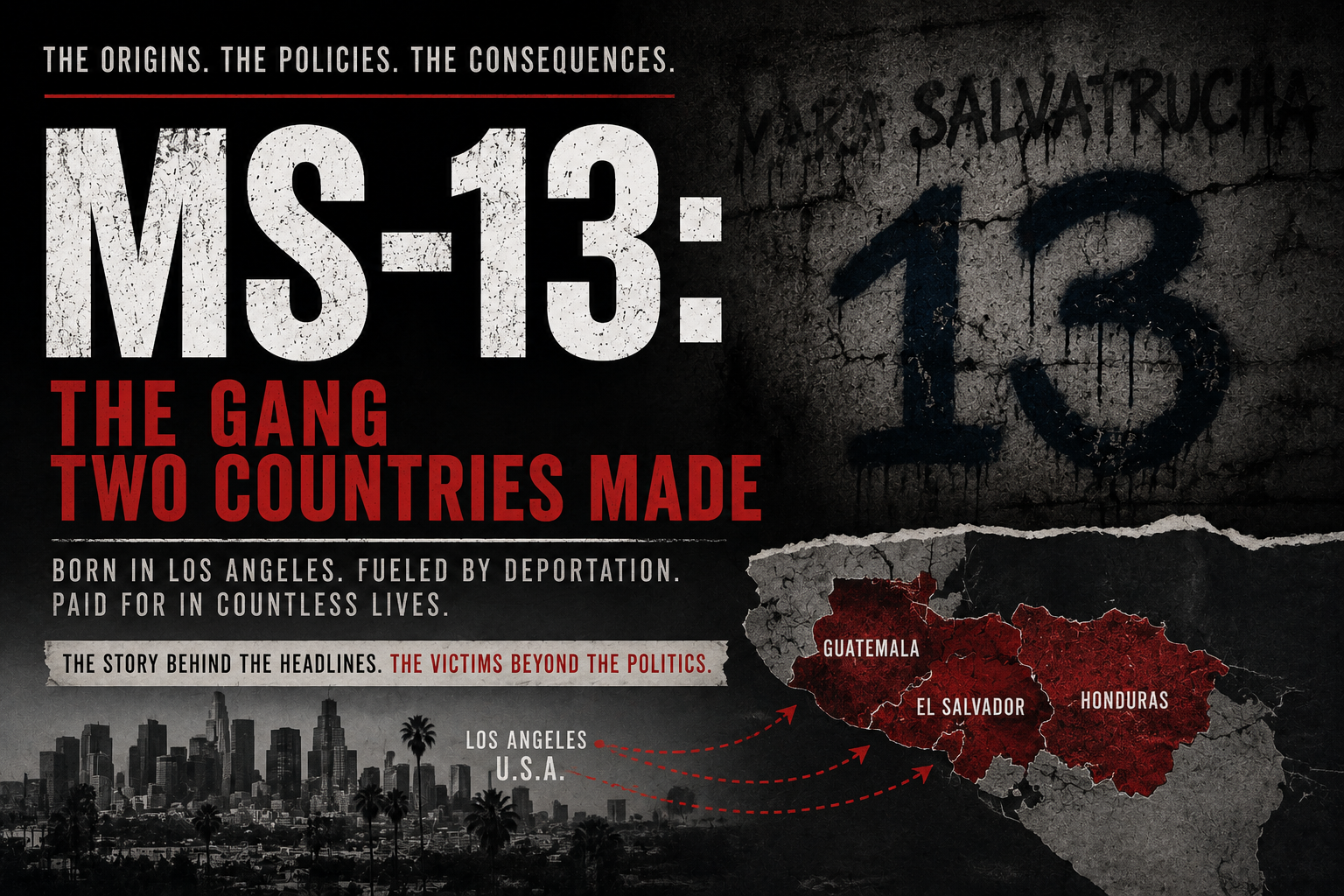
Those neighborhoods were not welcoming. Many were already dominated by powerful, established gangs who preyed on weaker cultural groups. Young Salvadoran immigrants found themselves isolated, facing language barriers, discrimination, and violence. In response, groups of Salvadoran youths formed their own organizations for protection, and one of those groups eventually became Mara Salvatrucha. MS-13 emerged in Los Angeles among Salvadoran youths seeking protection and solidarity in neighborhoods dominated by established gangs.
The name itself carries that history. “Mara” is a slang word associated with gangs in Central America; “Salvatrucha” references Salvadoran identity. The “13” is commonly linked to the letter M—the thirteenth letter of the alphabet— and the gang’s early alliance with the Mexican Mafia. What began as a self-protective street presence carried something darker beneath it: some early members had been exposed to the violence of the Salvadoran Civil War, and a small number reportedly had military or guerrilla experience, influences that helped shape some of the gang’s early culture and tactics.

Deported Back to Nowhere
The story of MS-13’s transformation into a transnational criminal organization is, in significant part, a story about American immigration enforcement.
During the 1990s and 2000s, U.S. immigration policies led to the deportation of thousands of individuals convicted of crimes, including gang members. From 2001 to 2010 alone, nearly 130,000 foreign nationals were deported to Central America because of criminal convictions, primarily to the Northern Triangle countries of El Salvador, Guatemala, and Honduras. A significant number had come to the United States as children. They spoke English. They had no meaningful ties to the countries they were sent to.

Those countries were still recovering from armed conflict, economic instability, and weak governmental institutions. Prison systems were overcrowded, law enforcement resources were thin, and opportunities for young people were scarce. As deported gang members arrived, they brought gang structures, recruitment methods, and criminal networks with them. Many returned to countries with weak institutions, overcrowded prisons, and few opportunities for reintegration. Gang networks quickly took root in those conditions.
Rather than eliminating the problem, deportation internationalized it. The gang established footholds throughout Central America and expanded through extortion, drug trafficking, weapons trafficking, and violent intimidation. Historically, MS-13 exercised territorial control over many communities in El Salvador, though that influence has been significantly disrupted by the government’s ongoing crackdown.
A Reputation Built on Brutality—and a More Complicated Reality
MS-13 developed a reputation for extreme violence, and it earned much of it. Law enforcement agencies have linked the gang to murders, assaults, kidnappings, and extortion schemes, often carried out with methods—machetes, beatings—designed to terrorize as much as to kill.
The 2016 murders on Long Island became the defining American case. Alexi Saenz, leader of the Brentwood/Central Islip chapter of the Sailors clique, was ultimately sentenced to 68 years in federal prison for his role in eight murders. His brother Jairo Saenz, the clique’s second-in-command, pleaded guilty in January 2025 to racketeering charges involving seven murders. “I did these things, and I knew they were wrong,” he said in Spanish through a translator after his lawyer read his accounts of the killings. Nisa Mickens, prosecutors said, sustained significant sharp force trauma to her face and blunt force trauma to her head; Kayla Cuevas’s body was discovered the following day. The case became a national reference point—invoked repeatedly to justify immigration enforcement sweeps that frequently caught unaffiliated immigrants in their wake.
Those acts cultivated the gang’s fearsome image. But criminologists caution against viewing MS-13 as a monolithic organization with centralized control over every crime committed in its name. The gang operates through local cliques with varying levels of organization and autonomy. Some are deeply embedded in organized criminal enterprises; others function more like traditional street gangs. This distinction matters because public narratives sometimes portray MS-13 as a singular criminal empire directing violence from a central command. The reality is more fragmented—a decentralized network of semi-autonomous cliques, each claiming territory and operating with significant independence. The estimated global membership ranges from 50,000 to 70,000, with 8,000 to 10,000 in the United States.
Recruitment and Vulnerability
Like many gangs, MS-13 frequently recruits vulnerable individuals. Researchers have identified a consistent cluster of risk factors associated with gang involvement: exposure to violence, family instability, poverty, social isolation, limited educational opportunities, community disorganization, and the absence of economic mobility. For some recruits, the gang provides a sense of belonging and protection; for others, joining is a survival strategy in neighborhoods where violence is already commonplace.
In El Salvador, the recruitment has been ruthlessly systematic. Gang members entered schools and identified boys as young as eleven, presenting them with a choice that was no choice at all: join or face lethal consequences. This is not incidental to how MS-13 sustains itself—it is the mechanism. Researchers and investigators have repeatedly found that the gang targets young people who already face violence, instability, and limited opportunities.
Recognizing these factors does not excuse criminal behavior. It highlights that gang violence is often rooted in broader social conditions rather than individual choices alone—and that any strategy ignoring these conditions is building on sand.
Immigration, Politics, and Public Perception
Few gangs have become as politically charged as MS-13. In recent years, it has been referenced constantly in debates over immigration policy, with politicians across the spectrum pointing to the gang as evidence for their preferred positions. The result has often been a deliberate blurring of the line between gang activity and immigration as a whole.
Law enforcement agencies have repeatedly emphasized that the overwhelming majority of immigrants are not involved in gang activity. At the same time, authorities acknowledge that transnational gangs can exploit migration routes, weak borders, and vulnerable populations. Both of these realities can be true at once. The challenge—and it is one the public conversation rarely meets—is separating evidence-based concern about organized crime from rhetoric that paints entire communities with a single brush.
The stakes of getting that distinction wrong are not abstract. In February 2025, the U.S. State Department designated MS-13 as a Foreign Terrorist Organization and Specially Designated Global Terrorist. The designation carries real legal weight, making any material support for the organization a federal crime. It has also been used to justify deportations to El Salvador’s CECOT megaprison, including in cases where individuals’ actual gang ties have been disputed.
The Bukele Crackdown—and Its Costs
In El Salvador, the government’s response to MS-13 and its rival Barrio 18 has been radical. President Nayib Bukele declared a state of exception in 2022, suspending constitutional rights and launching the mass-arrest campaign. By the official numbers, it worked: El Salvador’s homicide rate plummeted from 53.1 per 100,000 people before the crackdown to 1.9 per 100,000 in 2024, transforming a country that once had the highest murder rate in the world into one of the safest in the hemisphere by that single metric.
The human cost has been substantial. Tens of thousands have been detained, many without formal charges. Due process has largely been suspended. Human rights organizations have documented wrongful imprisonments, deaths in custody, and the permanent displacement of families. By 2024, at least 318,600 people were internally displaced across El Salvador, Guatemala, and Honduras as a result of gang violence and the upheaval surrounding it. The “Bukele model” has drawn admiration from leaders across Latin America and beyond—and a warning from observers who note that what looks like a solution by one measure can be a catastrophe by several others.

The Human Cost
Discussions about MS-13 tend to focus on gang members, arrests, and investigations. Far less attention is paid to the people on the other side of the violence.
Extortion forces families to surrender portions of their income to remain safe. Witnesses face threats for cooperating with authorities. Entire neighborhoods become trapped in cycles of fear, in which residents hesitate to report crimes at all. In Central America, this has driven displacement, migration, and widespread community trauma. Many of the people fleeing that violence are not gang members—they are ordinary residents trying to escape environments where gangs control the rhythms of daily life. In some cases, people fleeing gang violence become caught in political debates that treat migration itself as evidence of criminality.
Understanding reality is essential to understanding the gang’s true impact. The victims are not only the names that make headlines. They are also the families paying a monthly tax to stay alive, and the towns that emptied rather than submit.
Law Enforcement Responses
Authorities in the United States and Central America have deployed a wide range of strategies against MS-13: federal gang investigations, international law enforcement partnerships, racketeering prosecutions, intelligence sharing, targeted anti-gang operations, and community intervention programs. Many have produced significant arrests, and the Long Island convictions show that sustained federal effort can deliver accountability even years after the crimes.
But experts consistently note that enforcement alone rarely eliminates gang activity. Long-term reductions in violence tend to require investment in education, economic opportunity, community support, and violence-prevention programs. Without addressing the underlying conditions, gangs regenerate even after major crackdowns—recruiting the next eleven-year-old with no better option. The pattern repeats not because the arrests fail, but because the arrests were never going to be enough on their own.
Why It Still Matters
MS-13 is not the largest criminal organization operating in the Western Hemisphere. It is not the most sophisticated. By nearly every measure of revenue, logistics, and institutional power, the major cartels operate on an entirely different scale.
What MS-13 represents, and what makes it worth examining seriously, is something harder to quantify: the predictable consequence of cycles that no single nation has ever fully owned. A civil war, which the United States helped fund, created a generation of displaced people. Immigration enforcement created a feedback loop that exported gang culture to countries unprepared to receive it. Poverty, inequality, and the absence of legitimate opportunity did what they always do. And the communities left holding all of it—in Brentwood, in San Salvador, in the neighborhoods of Honduras—have paid the bill that policy produced.
The gang’s history demonstrates how local problems become international ones, and how violence spreads across borders when the underlying conditions go unresolved. It is possible to acknowledge the serious crimes committed by its members while also recognizing the social and historical forces that gave rise to the organization. Both realities matter. Without understanding both, meaningful solutions remain out of reach.
Nisa Mickens and Kayla Cuevas were fifteen and sixteen years old. That is where this story ends, and where accountability has to begin.
Where MS-13 Stands Today
In El Salvador, the gang that once ran entire neighborhoods has been forced into retreat. Bukele’s mass-arrest campaign has hollowed out its cliques, jailed much of its leadership, and broken the territorial control that made extortion possible—the steepest reversal of MS-13’s fortunes anywhere in its history, achieved at a cost to due process the country is still reckoning with.
Elsewhere, the story is persistence rather than defeat. The gang remains active across parts of Central America and in pockets of the United States—Long Island, North Carolina, and other communities where Central American populations are concentrated. Its decentralized clique structure, the same feature that has always kept it from maturing into a true cartel, also makes it stubborn: there is no single head to cut off.
In February 2025, the United States designated MS-13 a Foreign Terrorist Organization, a label that reshaped how federal agencies pursue the gang and opened the door to deportations to El Salvador’s megaprisons. It remains a standing focus of federal investigations and prosecutions—the Long Island convictions among the most visible—even as the conditions that feed it go largely unaddressed.
Final Thoughts
The story of MS-13 is usually told through shocking headlines and graphic crimes. Those stories are part of the picture, but they are not the whole of it. Behind the reputation lies a complicated history shaped by war, migration, deportation policy, and social inequality—much of it set in motion far from the streets where the violence now plays out.
Although MS-13 now operates across multiple countries, its origins are firmly rooted in Los Angeles. The gang’s later expansion into Central America was shaped by deportation policies, regional instability, and the legacy of the Salvadoran Civil War.
Understanding that complexity does not diminish the harm the gang has caused. It explains how such organizations emerge—and why preventing the next wave of violence will require more than arrests alone. The families of the victims on Long Island waited years for federal convictions. They deserve more than a footnote in a political speech. They deserve a reckoning with the full picture.
Every gang is a mirror held up to the conditions that made it. MS-13 reflects choices made in Washington and San Salvador alike, and the people who paid for them never got a vote. Naming that isn’t excusing the violence — it’s refusing to look away from where it comes from.
— Crime Central
Leave a Reply