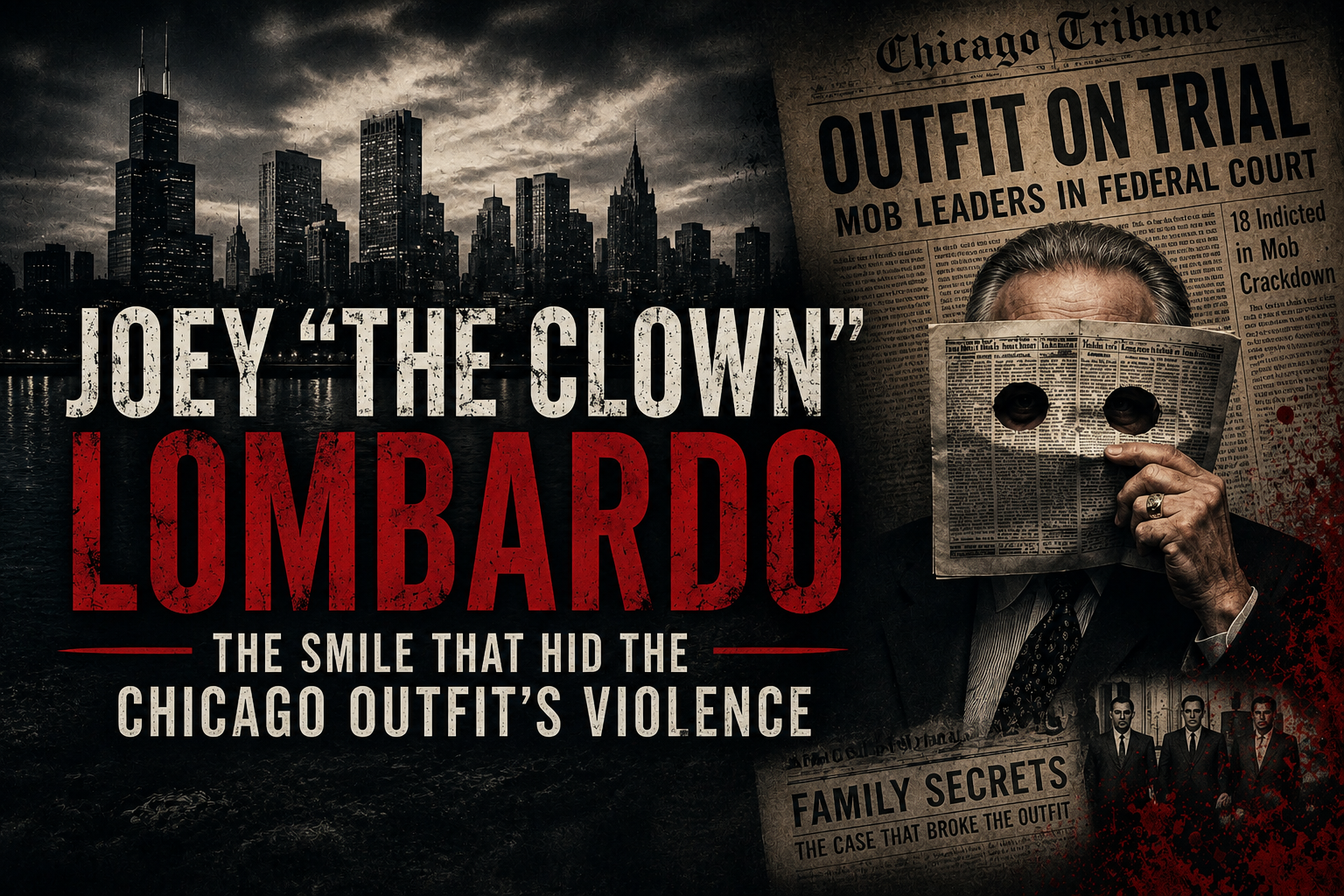
For decades, Joseph Patrick Lombardo cultivated an image of harmlessness. Behind it was a conviction for racketeering, organized crime leadership, and the murder of a federal witness killed before he could testify.
Read Time: 15 minutes
The Man Behind the Nickname
He joked with reporters. He made theatrical exits from court. In one of the most memorable images associated with him, he walked out of a courthouse holding a newspaper with eyeholes cut into it, turning himself into the kind of figure people laughed about and remembered. The nickname—”Joey the Clown”—seemed to fit.

It was misleading.
Joseph Patrick Lombardo was born Giuseppe Lombardi on January 1, 1929, in Chicago—the son of Italian immigrants and one of eleven children. He dropped out of high school, eventually Americanized his name, and joined the Chicago Outfit in the 1950s, beginning his career as a jewel thief and juice-loan collector. He rose steadily through the organization’s ranks, eventually serving as its Consigliere—its senior advisor—making him one of the most powerful figures in one of the most powerful criminal organizations in American history.

His associates never dared call him “the Clown” to his face.
By the time of Operation Family Secrets, prosecutors portrayed Lombardo as one of the Outfit’s most influential leaders, responsible for directing and facilitating organized criminal activity over several decades. The jokes did not make the violence less real. The nickname did not soften the consequences.
The Chicago Outfit and the Myth of the “Colorful” Mobster
American organized crime has long been filtered through movies, television, books, and local legends. In Chicago especially, the legacy of Al Capone helped create a public fascination with gangsters as larger-than-life figures—sharply dressed men, backroom deals, loyalty codes, and dramatic betrayals.
That image hides a much darker reality.
The Chicago Outfit was not simply a group of men committing isolated crimes. It functioned as a criminal enterprise. Its power came from illegal gambling, extortion, loansharking, labor racketeering, political corruption, and violence. It relied on fear, silence, and the threat of violence to maintain its influence. Businesses were pressured into compliance. Witnesses were threatened. People who cooperated with law enforcement could be marked as enemies.
Lombardo rose within that world. By the time he became a major Outfit figure, the organization had moved beyond public spectacle of the Capone era and into a more sophisticated model of criminal influence. It did not need constant violence to maintain power. Its reputation did much of the work.
That is one reason Lombardo’s public image matters so much. He appeared eccentric, even funny—but prosecutors argued that his real power came from his position inside an organization built on intimidation. The performance was the point. It kept attention off the violence underneath.
The Outfit’s Power: Money, Fear, and Silence
Organized crime depends on more than violence. Violence is often the final tool, not the first one. The real power lies in the fear that violence might happen. The threat alone is often enough to keep victims silent.
The Outfit’s reach extended into Teamsters pension funds, Las Vegas casinos, and political corruption at multiple levels. That overlap between legitimate and illegitimate spaces made organized crime difficult to prosecute—and made it dangerous for victims and witnesses to come forward.
When a criminal organization has a reputation for retaliation, silence becomes part of the system. Investigations stall. Witnesses recant or disappear. Families live for years with knowledge they cannot speak aloud.
That is the world Daniel Seifert entered.
Daniel Seifert: The Man Behind the Case
Daniel Seifert was not a mob legend. He was not a famous criminal. He was a businessman, a husband, and a father.

In the early 1970s, Seifert became connected to a business venture that drew federal scrutiny—a scheme involving the embezzlement of approximately $1.3 million from a Teamsters pension fund, routed through a plastics company. When federal investigators came knocking, Seifert made a decision that would cost him his life: he agreed to cooperate and serve as the government’s star witness. Word got out that he was not only cooperating with federal investigators but was the only person who could directly link Lombardo to the case.
Lombardo made clear there was no hiding from him. On more than one occasion, Seifert’s son Nick recalled seeing Lombardo sitting in a car outside their home. Nick, then a child, had wandered up and said hello, wondering why “Uncle Joe” wasn’t coming inside. His father’s reaction when Nick mentioned the encounter made it clear that the danger had arrived at their doorstep.
The morning of September 27, 1974, Daniel Seifert drove his family to his small fiberglass factory in Bensenville, Illinois. His wife Emma was making coffee. His four-year-old son Joe had been playing with his toys. Daniel had stepped outside when a group of masked men pushed through the back door. One of them forced Emma and her son into a bathroom, telling them it was a robbery and that they wouldn’t be hurt.
Daniel Seifert was murdered execution-style. His wife was holding their young son in her arms.
That detail should never be treated as background information. It is central to understanding the case.
Witness intimidation is not abstract. It does not only affect the person expected to testify. It affects spouses, children, extended family, and entire communities. When someone is killed for cooperating with law enforcement, the message is meant to travel. It tells others: stay quiet, or this could happen to you.
Why Seifert’s Murder Mattered
Daniel Seifert’s murder became one of the central crimes used to prove Lombardo’s role in the Outfit’s violence. He was killed because he became useful to the justice system and dangerous to the organization. The murder was not random. It was a calculated act in service of a criminal organization—a fact that later became critical to the federal case.
Organized crime stories often linger on the men at the top. The real story is usually found in the families left behind. Seifert’s children grew up under the weight of an unsolved murder, a father missing, and a killer walking free.
Operation Family Secrets
For decades, the Chicago Outfit seemed almost untouchable. The organization’s power depended on secrecy and fear. Major accountability was difficult. Investigations stalled, and cases collapsed.
Operation Family Secrets changed that.
The case became one of the most important organized crime prosecutions in Chicago history, targeting multiple Outfit figures and focusing on violent crimes that had remained unresolved for years. One of the reasons it succeeded was cooperation from inside the Outfit world itself. Frank Calabrese Jr. contacted the FBI from prison and helped expose his own father. Nicholas Calabrese, a seasoned Outfit insider, became the first made member of the Chicago Outfit to cooperate with the government—and proved to be key to the case.
Their cooperation broke through a wall of silence that had protected the organization for decades. The name “Family Secrets” was fitting in more ways than one.
In April 2005, Lombardo was indicted along with thirteen other defendants. The indictment attributed eighteen killings to the Outfit dating back to the 1970s. When federal agents moved to make arrests, they discovered Lombardo had vanished.
He became a fugitive. While at large, he sent letters to his attorney—formally addressed to the presiding judge—claiming innocence and requesting bail. “I am no part of an enterprise or racketeering[sic],” he wrote. “About the 18 murders in the indictment, I want you to know that I was not privy before the murders, during the murders, and after the murders.”
After more than eight months as a fugitive, Lombardo was captured outside an Elmwood Park home in January 2006. Federal agents had located him after he visited a dentist for an abscessed tooth—the dentist was the brother of deceased Outfit figure Tony Spilotro.
The Trial
The Operation Family Secrets trial began in 2007 and became a landmark moment in the federal fight against organized crime in Chicago. Prosecutors presented evidence tying the defendants to the Outfit’s criminal structure and to violent acts committed in service of that enterprise.
Lombardo took the stand in his own defense, denying any involvement in Seifert’s murder and claiming to have been at a Chicago police station reporting a stolen wallet at the time of the killing. The jury did not accept this alibi. Federal prosecutors had presented Lombardo’s fingerprint on the title application for a car used in the murders, and employees of an electronics store who identified him as the purchaser of a police scanner used to track Seifert’s movements in the days before the killing.
On September 10, 2007, Lombardo was convicted of racketeering, extortion, loan sharking, and murder. On September 27, 2007—thirty-three years after Daniel Seifert’s death—the jury returned special verdicts finding Lombardo responsible for Daniel Seifert’s murder.
At sentencing in 2009, Lombardo, then 80 years old and seated in a wheelchair, told the court he was “positively not guilty.” Judge James Zagel addressed him directly: “In the end, we are judged by our actions, not by our wit or our smiles. In cases like this, we are judged by the worst things we have done, and the worst things you have done are terrible.”
He sentenced Lombardo to life in federal prison.
For Seifert’s family, the conviction came more than three decades after the murder. That delay matters. Justice delayed does not erase the years a family spends waiting, and it does not return the person who was killed. But it can create a public record, name what happened, and challenge the silence that allowed the crime to remain unresolved for so long.
The Racketeer Influenced and Corrupt Organizations Act
The Racketeer Influenced and Corrupt Organizations Act—RICO—became one of the federal government’s most important tools against organized crime precisely because it addressed something earlier prosecution strategies missed.
Before RICO, prosecutors often had to focus on individual crimes: one murder, one extortion, one gambling operation. That approach could miss the larger structure. Organized crime groups are not just collections of isolated offenses; they are enterprises. Lombardo became one of the federal government’s prominent organized-crime targets during the RICO era, and the legal framework that eventually brought him down in Operation Family Secrets was built on RICO’s logic: that different crimes committed in service of the same criminal organization can be prosecuted together as a pattern of racketeering activity.
That framework helped expose the Outfit not as folklore, but as what it was—an organized criminal network that corrupted institutions, silenced witnesses, and used violence to protect its power.
Witness Intimidation and the Cost of Cooperation
The justice system depends on people being able to report crimes, cooperate with investigators, and testify in court. When witnesses believe they will be harmed for speaking, cases collapse. Criminal organizations understand that. Sometimes one act of violence is enough to silence many people for many years.
Seifert’s murder resonated far beyond a single homicide. It represented the kind of violence that protects criminal power. For victims’ families, it creates a second layer of harm: they lose someone they love, and then they may have to watch their case remain unsolved for years because the organization responsible is shielded by fear.
Joe Seifert said he spent every day after the 2009 sentencing wondering how long Lombardo would survive in federal prison. Nick Seifert told the court his marriage had dissolved because of the fear organized crime had brought into their lives.
Lombardo died at ADX Florence, the federal supermax prison in Colorado, on October 19, 2019, at the age of 90.
Daniel Seifert was 29 years old when he was killed.

The Problem with Mob Mythology
Joey Lombardo’s story is a precise example of why true crime coverage of organized crime requires care.
Mob stories are often framed through charisma. The nicknames are catchy, and the courtroom behavior can be strange enough to become entertainment. The newspaper-with-eyeholes photograph is genuinely strange, but that framing makes violence feel distant—almost fictional. It turns convicted criminals into characters and asks audiences to be entertained rather than informed.
The historical record tells a different story. Organized crime harms people in direct and indirect ways. It exploits addiction through gambling and traps people through debt. It corrupts unions and businesses and teaches communities that speaking up can be dangerous, even cost your life. When the public remembers Lombardo mainly as “Joey the Clown,” it risks remembering the performance more than the harm.
The better question is not whether he was colorful, but what that colorfulness helped hide.
Why This Case Still Matters
Operation Family Secrets is often discussed as a triumph of federal law enforcement, and in significant ways. Daniel Seifert was not a blameless figure. He had been a participant in pension fraud schemes before he chose to cooperate. But his cooperation made him a target, and the government could not protect him. His murder went unpunished for a generation.
Modern organized crime may look different than the neighborhood crews of the twentieth century, but the underlying patterns remain familiar: profit, corruption, intimidation, and exploitation. The Lombardo case remains important because it shows how long criminal organizations can survive when fear protects them—and how difficult it can be to bring justice once violence has silenced witnesses.
Joey “The Clown” Lombardo spent years hiding behind performance, public antics, and the mythology of the mob. Operation Family Secrets stripped away much of that mythology. What remained was not a charming outlaw, but a convicted organized crime leader tied to one of Chicago’s most painful chapters of mob violence.
The smile may have made him famous—but the harm is what should be remembered.
Leave a Reply