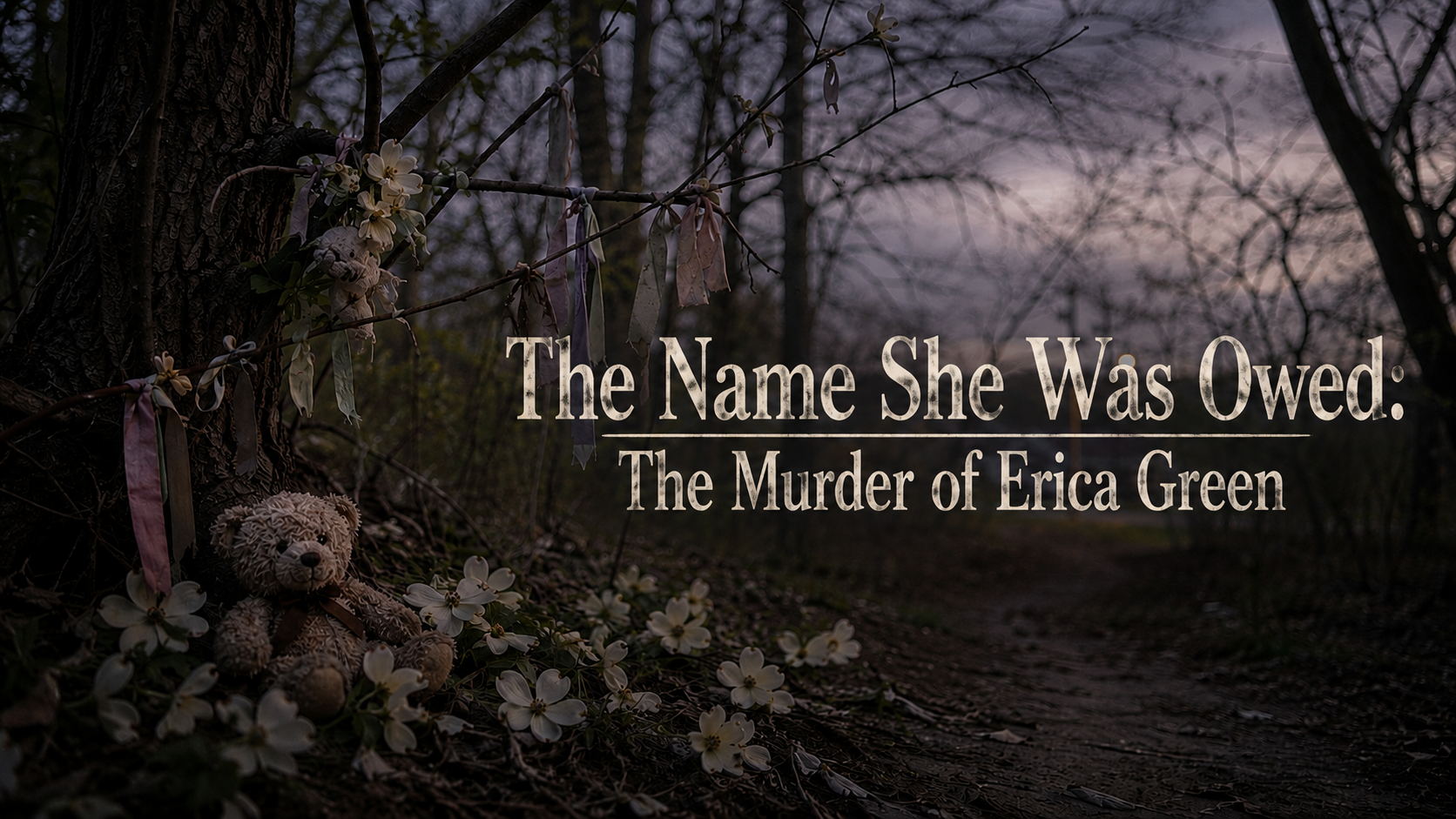
The dogwoods were still blooming in Kansas City the week a police officer walked into a wooded lot near 59th and Kensington and found what no one is trained to find. It was April 28, 2001. In the brush across the street from Hibbs Park lay the body of a small Black girl, badly beaten and left there without identification. Three days later, investigators found her head in a garbage bag less than two hundred yards away. No missing-person report had been filed. It appeared no one was looking for her.
For four years, the nation called her Precious Doe. It would take a grandfather in Oklahoma, an activist with a comic book press, and a Black community newspaper to restore the name that had been obscured by the circumstances of her death: Erica Michelle Marie Green.
The Body in the Brush
She was found within walking distance of homes, of churches, of streets where children played. The medical examiner determined she had been beaten with an ashtray—recovered at the scene, wiped of prints and DNA—and kicked with enough force to cause catastrophic head injury. The decapitation, investigators concluded, had been an attempt to prevent identification.
For four years, it did.
The FBI took blood samples from the families of missing Black girls across the country. Forensic artists released sketches and digital reconstructions. The case ran on America’s Most Wanted. For a brief moment in 2002, hopes lifted when Florida child welfare officials realized they had lost track of a five-year-old named Rilya Wilson, who had vanished from her foster care more than a year earlier. DNA tests ruled her out.


She lay in a county grave under a marker that read only what the city knew of her: Precious Doe.
A City That Refused to Forget
Kansas City did something unusual; it did not let her go.
A makeshift memorial of teddy bears and handwritten poems grew at the edge of the wooded lot. Volunteers staffed tip lines, and hundreds attended candlelight vigils for a child whose face they had only seen in a sketch. A formal Precious Doe Committee was organized to keep pressure on investigators and to keep her face in the public eye. Community activist Alonzo Washington—a comic book publisher who had spent years working to draw attention to missing Black children—bought ads in the local press, year after year, refusing to let her disappear from the city’s conscience.
It is worth pausing here: the investigative resources eventually marshaled—federal blood draws, national broadcast appeals, professional reconstructions—were extraordinary. Yet none of them identified her. The break in the case came instead from a man in Muskogee, Oklahoma, who picked up a telephone.
The Tip No One Would Take
His name was Thurman McIntosh. He was 81 years old when he started calling. McIntosh was a World War II veteran and a retired butcher. He had moved to Oklahoma in his later years to help his brother run a nursing home. He was also the step-grandfather, by marriage, of a young man named Harrell Johnson. And in April of 2004, he picked up his phone and called Kansas City detectives to tell them that his own grandson had killed the child the country was calling Precious Doe.
A detective took his statement. Nothing happened.
McIntosh called again and again. By his own count, he contacted Kansas City detectives 40 to 50 times over the course of a year. He later said he was treated as if he were “some crack-head looking for money.” His calls were not returned. His tips were not followed up on. A year passed without progress.
In the spring of 2005, frustrated and running out of options, McIntosh called the Kansas City Call—one of the city’s Black newspapers. The editor passed him to Alonzo Washington, the activist whose ads had been the only thing keeping Erica’s face in the public eye. McIntosh mailed Washington a package containing photographs of his grandson’s wife with several children, as well as hair samples from both the woman and one of the children. He believed that the child was Precious Doe.
Washington took the package to the police. This time, detectives followed up. They drove to Muskogee, and the DNA matched.
On May 5, 2005, a sign appeared at the Precious Doe memorial. Someone had written it by hand. It read: My Name Is Erica Michelle Marie Green.
Who She Was

Erica was born on May 15, 1997, in McLoud, Oklahoma. She would have turned four less than three weeks after her body was found. No one in Oklahoma had reported her missing because no one in Oklahoma knew she was dead. Her mother, Michelle Johnson, had moved her daughter to Kansas City to stay with a friend. After Erica’s death, Michelle returned to Muskogee, married Harrell Johnson within the year, and lived openly in the town she came from.
According to trial testimony, the fatal assault took only seconds. Michelle Johnson said her husband, Harrell—20 at the time and high on PCP—kicked Erica in the head because the child would not go to sleep. He told prosecutors he had been disciplining her. A pediatric neurosurgeon later testified that if Erica had been taken to a hospital quickly, the injury was likely survivable.
Michelle Johnson did not take Erica to a hospital. According to her testimony, she placed the child in a bathtub of cold water and watched her stop breathing. The couple, both facing outstanding warrants, feared arrest if they sought help. Harrell Johnson then dismembered the body in an apparent attempt to prevent identification. Prosecutors said he first placed Erica’s body in a dumpster at a church parking lot, then moved it to the wooded lot near Hibbs Park, leaving the trash bag nearby before the couple returned to Oklahoma.
She was three years old, and her death took the time it takes to cross a kitchen.
Justice For Erica

Harrell Johnson was indicted for first-degree murder in 2005. His trial took place in October 2008—more than seven years after Erica’s death. Michelle Johnson, having pleaded guilty to second-degree murder the year before, took the stand against him. She described the events of that night, including the kick, the bathtub, and her decision not to seek medical help.
The jury deliberated for three hours. Harrell Johnson was convicted of first-degree murder, child endangerment, and child abuse. Prosecutors had agreed not to seek the death penalty in exchange for his withdrawal of a change of venue motion. He was sentenced to life in prison without parole and sent to Potosi Correctional Center, a maximum-security prison in eastern Missouri.
Michelle Johnson received 25 years on four stacked counts: second-degree murder, abandonment of a corpse, endangering the welfare of a child, and tampering with physical evidence. She was denied parole at every review and is serving the full sentence at Chillicothe Correction Center.

Thurman McIntosh did not live to see the anniversary of the conviction. He died in Muskogee in March 2010 at the age of 86. Before his death, he was asked how he felt about what he had done, and he said: “My time’s getting short, and I did my job.”
Why It Still Matters
There are details of this case that are easy to look at and look past—and one of them is the year.
For an entire year, a member of a killer’s own family told Kansas City police, in plain language, who killed Precious Doe. He gave them a name, a city, and eventually photographs and DNA. And for an entire year, nothing happened. The case was solved not when detectives finally followed the lead, but when McIntosh routed around them—first to a Black community newspaper, then to a private activist who handed the package to police a second time, this time with enough public attention attached that it could not be ignored.
That gap is central to the story.
Erica Green was Black. She was three. She was not reported missing because the only adults responsible for her were the people who killed her. The systems meant to identify and protect children like her—child welfare, missing-person databases, interstate police communication, and the handling of family tips—failed repeatedly. The case was solved only after Thurman McIntosh and Alonzo Washington forced authorities to act.
In the years since, Erica’s case has also led to policy changes. In Oklahoma, the Department of Corrections agreed to notify DHS when an incarcerated woman is about to give birth so the agency can plan for the newborn’s placement when warranted. DHS has referred to these procedures as “Erica’s Rule.” The policy followed legal action by Erica’s biological father, who argued that earlier safeguards might have made her disappearance visible sooner. In Kansas City, a permanent Children’s Memorial was unveiled at Hibbs Park on May 15, 2025, bearing the names of more than 120 children killed by violence between 2001 and 2024. Erica Green’s name appears prominently at the top.
But the broader pattern remains. Reporting by the Kansas City Defender in 2026, based on 27 daily KCPD missing-person snapshots, found that Black girls in Kansas City were listed as actively missing at roughly four to five times the rate of white girls, and that Black women and girls accounted for nearly 30 percent of active missing-person cases in those snapshots while making up about 14 percent of the population. The conditions that allowed Erica Green to lie unidentified for four years—the conditions that allowed a man’s tip to sit untouched for another year on top of that—are not historical. They are present-tense conditions.
Final Thoughts
Twenty-five years on, the most haunting fact about this case is not the violence. It is the silence around the violence. A three-year-old child was beaten to death and beheaded in the spring of 2001, and no one—not a teacher, not a neighbor, not a doctor, not a social worker—noticed she was missing. She was killed and dumped by the people who were supposed to love and protect her. The man who finally turned them in was treated as a nuisance.
We owe her name. That is the smallest possible thing we can owe her, and Kansas City spent four years unable to pay it. The least we can do, a quarter-century later, is keep saying it: Erica Michelle Marie Green. Born May 15, 1997. Killed April 28, 2001.
References
Associated Press. (2005). Community mourns “Precious Doe” at service. The Spokesman-Review. https://www.spokesman.com/stories/2005/may/08/community-mourns-precious-doe-at-service/
Associated Press. (2005). 2nd funeral brings closure in “Precious Doe” case. Lawrence Journal-World. https://www2.ljworld.com/news/2005/aug/19/2nd_funeral_brings_closure_precious_doe_case/
Associated Press. (2007). Mom of “Precious Doe” pleads guilty to murder. NBC News. https://www.nbcnews.com/id/wbna20763724
CBS News. (2005). Charges in “Precious Doe” case. CBS News. https://www.cbsnews.com/news/charges-in-precious-doe-case/
CBS News. (2005). Persistence paid in “Precious” ID. CBS News. https://www.cbsnews.com/news/persistence-paid-in-precious-id
CNN. (2005). Mother, stepfather charged in “Precious Doe” killing. Cable News Network. https://www.cnn.com/2005/US/05/05/precious.doe/
Cosgrove-Mather, B. (2005). Precious Doe born in prison. CBS News. https://www.cbsnews.com/news/precious-doe-born-in-prison/
Democracy Now! (2022). How Kansas City police ignored warnings a killer targeted Black women, until one escaped. Democracy Now! https://www.democracynow.org/2022/10/18/missouri_police_ignored_claims_black_missing
Deseret News. (2005). Mystery of “Precious Doe” solved. Deseret News. https://www.deseret.com/2005/5/6/19890937/mystery-of-precious-doe-solved/
Fox News. (2007). Mother of Precious Doe pleads guilty in daughter’s death. Fox News. https://www.foxnews.com/story/mother-of-precious-doe-pleads-guilty-in-daughters-death
Harrison, V. W. (2026). The headlines called her Precious Doe. Her name was Erica Green. The Kansas City Defender. https://kansascitydefender.com/missing-black-persons/the-headlines-called-her-precious-doe-her-name-was-erica-green/
KCTV5. (2026). Vigil honors Erica Green on what would have been her 29th birthday. KCTV5 News. https://www.kctv5.com/2026/05/16/vigil-honors-erica-green-what-would-have-been-her-29th-birthday/
KSHB 41 News. (2017). Community remembers Precious Doe on her birthday. KSHB 41 News. https://www.kshb.com/news/local-news/community-remembers-precious-doe-on-her-birthday
KSHB 41 News. (2026). KC remembers Erica Green “Precious Doe” on 29th birthday; story resonates 25 years later. KSHB 41 News. https://www.kshb.com/news/local-news/missouri/jackson-county/kc-remembers-erica-green-precious-doe-on-29th-birthday-story-resonates-25-years-later
Lewis, R. (2013). DHS to implement “Erica’s Rule,” protecting kids of incarcerated parents. News On 6. https://www.newson6.com/story/5e3641be2f69d76f6205d28f/dhs-to-implement-ericas-rule-protecting-kids-of-incarcerated-parents
NBC News. (2005). Innocent pleas for parents in “Precious” death. NBC News. https://www.nbcnews.com/id/wbna7808951
NBC News. (2005). Mom, stepfather charged in killing of “Precious Doe.” NBC News. https://www.nbcnews.com/news/amp/wbna7747095
PBS NewsHour. (2022). Woman who escaped kidnapper highlights often ignored plight of missing Black women. PBS NewsHour. https://www.pbs.org/newshour/show/woman-who-escaped-kidnapper-highlights-often-ignored-plight-of-missing-black-women
Reaves, J. (2001). Decapitated girl remains unidentified weeks after slaying. ABC News. https://abcnews.go.com/US/story?id=93102&page=1
Stafford, K. (2023). Kansas City police dismissed a Black news site’s reports of missing women. Then one showed up. Capital B News. https://capitalbnews.org/kansas-city-kidnapped-woman-escape/
Wicentowski, D. (2022). As Black women go missing in Kansas City, Black community looks to itself for solutions. KCUR. https://www.kcur.org/news/2022-12-27/as-black-women-go-missing-in-kansas-city-black-community-looks-to-itself-for-solutions
Wikipedia contributors. (2026). Murder of Erica Green. In Wikipedia. https://en.wikipedia.org/wiki/Murder_of_Erica_Green
Leave a Reply