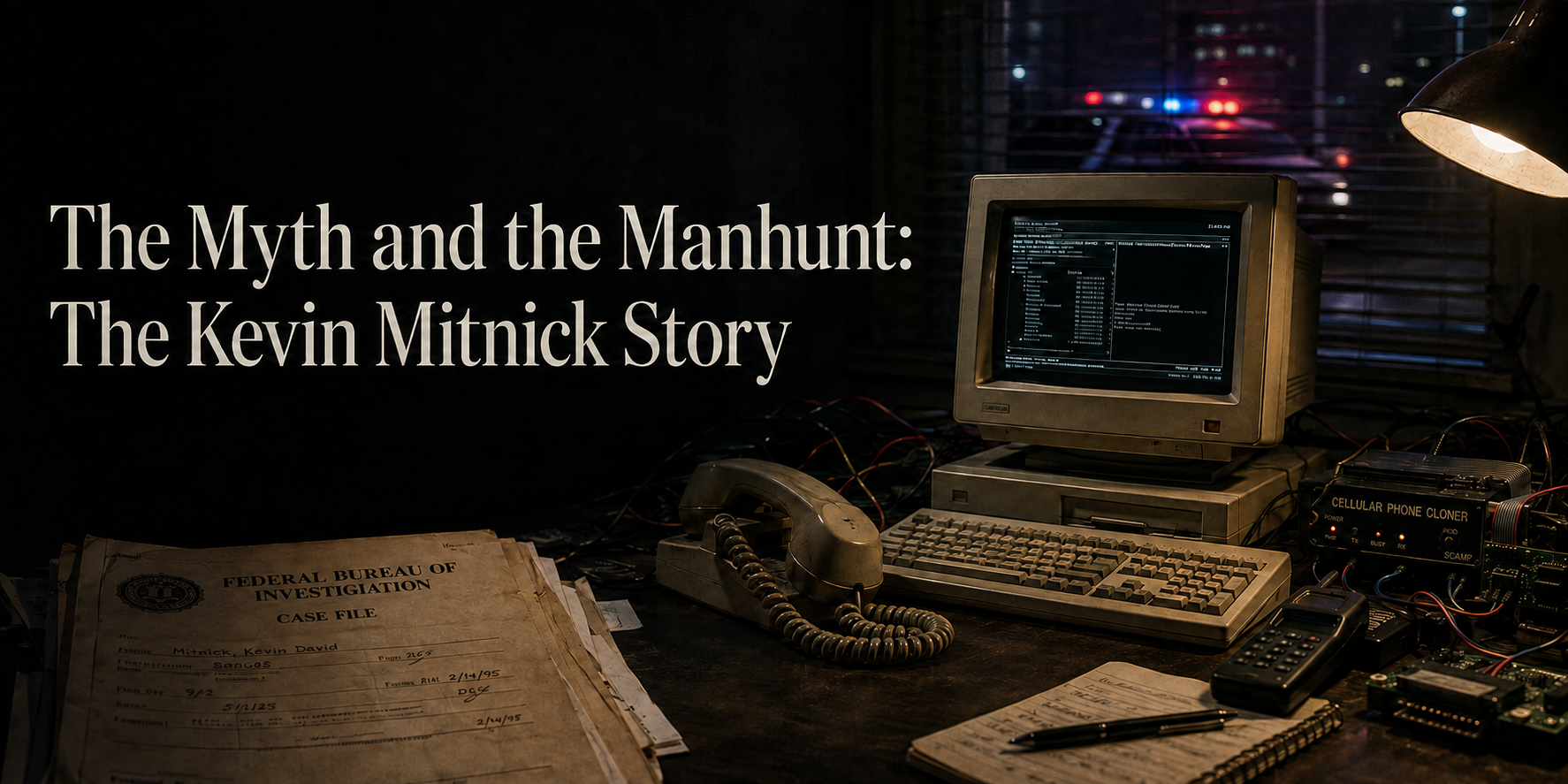
He committed real crimes. The case against him was built out of something else.
Kevin Mitnick committed real and repeated computer and telecommunications crimes, but the public case against him grew far beyond his documented conduct. Disputed loss estimates, years of pretrial detention, restrictive release conditions, and sensational reporting helped transform him from a persistent intruder into a nearly mythical threat. This article examines the crimes Mitnick admitted to, the claims that surrounded his prosecution, and the complicated legacy of a man remembered as both a cybercriminal and a symbol of government overreach.
Read time: 15 minutes
The apartment complex in Raleigh, North Carolina, was the kind of place that generates no stories at all. Beige siding, a parking lot, units rented month to month by people passing through the Research Triangle on short contracts.
In the early hours of February 15, 1995, federal agents knocked; the man inside had been living there under a name that was not his. Inside, agents found cloned cellular phones, more than a hundred cloned cellular codes, and false identification documents.

Both halves of that scene are essential to understanding the case: Mitnick was not accused of committing physical violence, but agents found what federal authorities described as a working kit for sustained, deliberate telecommunications fraud. The newspapers presented a third version: the capture of what their coverage portrayed as the most dangerous computer criminal in America. That version, rather than either of the more complicated realities, helped shape how the public understood cybercrime for decades.
The Boy Who Asked Nicely
Kevin David Mitnick was born in Los Angeles on August 6, 1963, and raised in the San Fernando Valley by a single mother who worked as a waitress. Long before most American households had personal computers, he became fascinated by telephone networks, radio equipment, and the hidden infrastructure that allowed modern life to function.
Mitnick later described one of his earliest schemes: learning how Los Angeles bus transfers were validated, obtaining the same type of punch drivers used, and collecting unused transfer slips discarded near the depots. By his account, he rode the city free for months. The story comes primarily from Mitnick himself and should be read accordingly, but it captures the method that would define everything after. He did not defeat the system; he asked a driver where to buy the punch, and the driver told him.
Mitnick began using these methods as a teenager when he entered the world of phone phreaking, a subculture centered on exploring and manipulating telephone networks—systems that offered far more than free calls, providing access to voicemail boxes, switching equipment, customer records, and the infrastructure connecting early computer networks. He discovered quickly that technical skill was only part of the equation. Employees held the passwords, access codes, internal directory numbers, and procedural knowledge he wanted. If he could persuade them he was a colleague, a technician, or an authorized customer, they would often hand it over voluntarily. A password difficult to obtain through code can often be acquired through a confident telephone call placed at the right hour.
Mitnick became exceptionally skilled at it, and his charm later became central to his public image. This framing carries a risk, because describing his offenses as clever conversations minimizes what they cost. The employees he deceived were unknowingly made instruments of a crime and then, frequently, subjects of an investigation. Companies spent weeks auditing compromised systems, replacing credentials, and determining whether proprietary information had been altered or redistributed, work that had to be done precisely because they could not know what an intruder had touched. Individuals lost control of private communications. Social engineering requires no physical force, but it still depends on violating trust. That is also why technical safeguards alone cannot eliminate it.
The First Major Conviction
Through the 1980s, Mitnick came into repeated contact with law enforcement over computer and telephone offenses. As a juvenile, he was placed on probation for taking computer manuals from Pacific Bell. He served six months in 1983 for breaking into computers at the University of Southern California, and a 1987 arrest involving a Santa Cruz software company produced three years of probation. His most significant early case involved Digital Equipment Corporation.
Mitnick and others gained unauthorized access to DEC’s network and copied proprietary software. He pleaded guilty to computer fraud and possession of unauthorized access devices, and in 1989 received a one-year prison sentence followed by three years of supervised release.
The case was unusual for its time. Federal courts were still learning how to evaluate crimes involving source code, digital access, and information that could be copied without being physically removed. Prosecutors and corporations calculated losses by estimating the commercial value of the software and the cost of investigating intrusions. At the same time, defense attorneys argued that copying information is not equivalent to depriving a company of its original. That disagreement would follow Mitnick for the rest of his life. The DEC case offered an early example of how widely loss estimates could vary. Littman later reported that the government told Judge Mariana Pfaelzer the loss was approximately $160,000 rather than the $4 million figure that had circulated publicly. According to Littman, the smaller figure represented the cost of identifying the security weakness exposed by Mitnick’s intrusion, rather than damage to the system itself.
After his release, Mitnick was barred from accessing certain computer and telecommunications systems. Near the end of his supervised-release term, authorities accused him of entering Pacific Bell voicemail systems. When a warrant was issued, he fled.
The Fugitive Years
For roughly two and a half years, Mitnick lived under assumed identities while continuing to access computer and telephone networks. He used false identification and cloned cellular credentials to mask his location. According to federal authorities, he gained unauthorized access to dozens of networks, copied proprietary software, obtained passwords, altered system information, and read private emails. His targets included Motorola, Nokia, Sun Microsystems, Fujitsu, Novell, and NEC, and much of what he pursued involved software, cellular technology, and the internal tools used to run computer networks.
Mitnick consistently maintained he explored these systems for the challenge and never intended to profit. The available evidence does distinguish him from cybercriminals who drain bank accounts, deploy ransomware, or sell personal data, and that distinction is real and legally meaningful. It is not exculpatory. He repeatedly entered systems without permission, took information that was not his, and used other people’s credentials to keep operating while a fugitive from a federal warrant.
The pursuit intensified in December 1994, when the computer of a cybersecurity specialist, Tsutomu Shimomura, was compromised. Files taken from Shimomura’s system were later traced through cellular and internet activity. Shimomura took the intrusion personally and joined the hunt, working with telephone companies and federal investigators as the search narrowed to Raleigh. He was not working alone. Accompanying the pursuit was a New York Times reporter named John Markoff.
From Defendant to Digital Supervillain
By the time of his arrest, Mitnick was no longer being covered as an ordinary computer-crime defendant. Markoff’s prominent reporting helped shape the version of Mitnick presented to the public: not merely an intruder who entered systems without authorization, but a potentially far-reaching threat to national security and critical infrastructure.
Markoff had already published a book on hackers featuring Mitnick substantially, and he covered Shimomura’s pursuit while traveling with it; the resulting book and film deals were reported to be worth around two million dollars. Two competing accounts landed in January 1996—Takedown, by Shimomura with Markoff, and The Fugitive Game, by investigative reporter Jonathan Littman, built on hours of telephone conversations with Mitnick while he was still running. Littman charged that Markoff had actively assisted the investigation while concealing his own involvement and the conflicts it produced. Markoff denied the allegations and accused Littman of libel. Neither account is neutral. Anyone studying the case should consult both books alongside the available court record and remain alert to the interests of everyone involved.
The disputed claims matter more than the feud. Mitnick denied wiretapping the FBI. He denied breaking into NORAD, a claim that implicitly linked him to WarGames and appears to have spread through repetition despite limited supporting evidence. Mitnick also maintained that he never intentionally damaged the systems he entered. Although his intrusions imposed investigative, security, and recovery costs, the available public record does not clearly establish that he deliberately destroyed data or disabled a system.
Then there is the most famous claim: that Mitnick could launch a nuclear missile by whistling into a payphone. There is no credible evidence that he could have accessed or activated a nuclear-launch system through a telephone. Mitnick later claimed that a prosecutor presented this possibility to a judge and that it contributed to the conditions of his confinement. That account has been repeated for decades but has not been verified through a publicly available transcript. This does not necessarily make it false, but it should be treated as Mitnick’s characterization of the proceeding rather than an established court finding.
The image of a nearly supernatural threat reflected genuine uncertainty about computers in the 1990s: the internet was arriving faster than journalists, judges, and legislators could learn what it did, and technical conduct got translated into language that made Mitnick appear able to control almost any electronic systems. His documented abilities were substantial enough without embellishment. He presented a legitimate security concern, particularly given his previous conviction, flight, false identities, and continued intrusions. At the same time, critics argued that sensationalized descriptions of what he might be capable of influenced how prosecutors, journalists, and the courts assessed the threat he posed.
What the Indictment Actually Said
The federal indictment ran to twenty-five counts involving wire fraud, computer fraud, possession of unauthorized access devices, interception of electronic communications, and damage to computers. Four statutes carried the case.
The Computer Fraud and Abuse Act prohibits certain forms of unauthorized access to protected computers. It has been amended repeatedly since its passage in 1986, and courts have continued to disagree about the scope of some of its central terms. Courts disagreed for years about whether the law covered only access to information a person was prohibited from obtaining or also covered the misuse of information a person was otherwise authorized to access. In Van Buren v. United States (2021), the Supreme Court adopted the narrower interpretation, although the decision did not resolve every dispute surrounding the statute. Mitnick was prosecuted under a statute whose boundaries were considerably less mapped in 1995 than they are now, which is worth holding in mind when evaluating both the charging decisions and the defense’s objections to them. The wire fraud statute applies when someone uses interstate electronic communications as part of a scheme to defraud; because computer and telephone activity routinely crosses state lines, wire fraud became a standard charge in early cybercrime prosecutions, and a notably flexible one. The unauthorized access device provisions cover passwords, cellular codes, account numbers, and similar credentials when used to obtain services or enter restricted systems, which is where the cloned codes recovered in Raleigh landed. Federal wiretap and electronic communications law supplied the interception counts, covering access to private email and communications without authorization.
Years in Pretrial Detention
Here the case stops being a hacker story and becomes a criminal justice story.
When Mitnick was arraigned in Los Angeles on September 30, 1996, he pleaded not guilty and was denied bail. His attorney, Donald Randolph, argued the denial was unwarranted; prosecutors successfully framed him as a flight risk. Randolph pursued the bail question as far as the U.S. Supreme Court. Mitnick spent approximately four years in custody before pleading guilty in 1999 and nearly five years in custody before his release in January 2000.
Detention of this kind operates under the Bail Reform Act of 1984, which permits a court to hold a defendant before trial on a finding of flight risk or danger to the community. The statute asks courts to make a predictive judgment about future conduct, and that judgment is only as good as the evidence behind it. In 1996, courts had limited precedent for evaluating the risks posed by someone with Mitnick’s particular combination of technical knowledge, previous convictions, and ability to manipulate telecommunications systems.
The parties also litigated whether he could use a laptop in custody to review the enormous volume of digital evidence against him. The government argued that his facility with computers made this too dangerous. The restrictions created a serious practical problem for the defense: much of the evidence was digital, but Mitnick’s access to the equipment needed to review it was limited because the government considered his computer skills a security risk. Mitnick later said that he spent eight months in solitary confinement. Without the detention records or a corresponding court finding, that duration should be understood as his account.
The government’s position was not frivolous, and it deserves stating at full strength. Mitnick had already violated supervised release once. He had continued accessing systems while a fugitive. He had used false identities and cloned credentials, and had demonstrated a practiced ability to manipulate telecommunications services, including—plausibly—from a facility telephone. On those facts, a flight-risk finding was defensible, and a continuing-danger finding was at least arguable.
A protest movement grew anyway. 2600: The Hacker Quarterly drove a “Free Kevin” campaign that put yellow bumper stickers on cars nationwide and turned an obscure trespass defendant into a civil liberties cause. The movement overcorrected badly, routinely describing the offenses as victimless when they were not, but it was responding to something real. The process had become the punishment.
It is possible to recognize the legal basis for detaining him and still question whether the duration and conditions were proportionate to the conduct ultimately covered by his plea. The $4,125 restitution order should not be used as a direct measure of that conduct because the judge reportedly based the amount largely on Mitnick’s ability to pay. That question is not rhetorical. It is the one the case leaves open, and courts still face its descendant: how should the justice system assess dangerousness when the alleged weapon is knowledge rather than an object?
The Arithmetic of Harm
The damages figures are central to understanding the case because loss is more than a descriptive detail in a federal fraud prosecution. Under the sentencing guidelines then in effect, the calculated loss could affect the offense level and sentencing range. The estimates could also influence how prosecutors, judges, and journalists understood the seriousness of the conduct, although loss was not itself a statutory formula for determining bail. A loss estimate can shape major legal and public judgments, making the method used to calculate it as important as the final number.
Collectively, the corporate victims were reported to have put Mitnick’s cost in the hundreds of millions, often framed as nearly $300 million.
The available descriptions of how the companies calculated these estimates raise substantial questions about what the figures represented. Sun Microsystems asserted that Mitnick’s copying of its Unix source code amounted to $80 million in damages, representing the full development value of the code. The same company was at that time providing that code to educational institutions and announcing plans to sell it to qualified developers for $100. Novell’s claimed loss of $75 million rested on identical logic: the source code Mitnick copied had cost $75 million to develop, therefore $75 million was the loss. That method treated the development value of the software as the loss created by a single unauthorized copy. Because copying a file does not deprive its owner of the original, using the software’s entire development cost as the resulting loss is highly contestable and does not establish that the company actually lost that amount.
2600 obtained and published letters the companies had sent to the FBI. The magazine argued that the correspondence showed investigators encouraging the companies to submit the broadest possible loss estimates. That interpretation came from a publication actively involved in the “Free Kevin” campaign and should be presented as an allegation rather than an established finding. The magazine also questioned why the companies did not appear to report corresponding losses to shareholders or securities regulators. Critics argued that the absence of those disclosures raised doubts about whether the companies themselves treated the estimates as realized financial losses. Whether disclosure was legally required would have depended on factors including materiality and how the companies accounted for the alleged harm. According to contemporary reporting, Randolph accused the government of inflating the estimates for improper purposes. Because the relevant pleadings were placed under seal, the underlying argument cannot be evaluated fully from the public record.
Judge Pfaelzer ordered Mitnick to pay $4,125 in restitution and described it as a “token” amount. Contemporary reporting indicates that the figure was based largely on what the court believed he could realistically pay, rather than a finding that the total losses amounted to $4,125.
That gap is easy to misread in either direction, and the governing law deserves a moment.
Restitution is not a damages finding. It compensates victims for losses the court treats as legally recoverable and directly attributable to the offense—a narrower category than everything a company might claim it lost. The legal framework also matters. Mitnick’s conduct and charges crossed the 1996 effective date of the Mandatory Victims Restitution Act, which changed how restitution is calculated in certain federal cases. Determining precisely how the court applied those rules would require reviewing the plea agreement and sentencing record. Without that record, the $4,125 figure cannot be treated as a judicial rejection of the larger loss estimates. The stronger criticism concerns how those estimates were calculated, presented, and repeated—not the final restitution amount.
What can be said without qualification is narrower and still damaging. A figure approaching $300 million circulated through press coverage and public argument, even though the available descriptions of its calculation were contested. Critics also pointed to the apparent absence of corresponding securities disclosures, although that absence does not by itself establish that the estimates were false. The dispute demonstrates why claimed losses should be accompanied by a transparent explanation of how they were calculated.
The Plea
In 1999, Mitnick pleaded guilty to seven counts arising from cases in multiple federal districts: four counts of wire fraud, two counts of computer fraud, and one count of unlawfully intercepting a wire communication. Judge Pfaelzer sentenced him to 46 months for those offenses plus 22 months for violating the supervised-release terms attached to his earlier conviction, 68 months in total. Because he had already spent years in federal custody awaiting resolution, he was released on January 21, 2000. The plea agreement resolved the case without requiring prosecutors to prove all twenty-five charged counts at trial, and Mitnick received credit for the years he had already spent in federal custody.
The mechanism deserves naming plainly, because it is the ordinary machinery of the federal system rather than anything exotic. Mitnick had been held without bail for approximately four years before pleading guilty, had limited access to the equipment needed to review a large volume of digital discovery, and faced loss figures drawn largely from disputed estimates submitted by the affected companies. The agreement largely reflected time he had already served. The plea prevented an adversarial trial of the government’s full case. Given the time Mitnick had already spent in custody and the possibility of a longer sentence if convicted at trial, accepting the agreement was a rational decision. On release, Mitnick characterized what he had done as ordinary trespass and said he had wanted to understand how the phone networks worked.
The Ban and the Reinvention
The supervised-release conditions that followed were unusually strict. Without approval from his probation officer, Mitnick could not possess or use computers, software, modems, cellular telephones, or other communications equipment, and he was initially barred from public speaking as well. The restrictions loosened over time, but he was not permitted back online until December 2002.
Some of this was defensible. Mitnick had returned to unauthorized activity after previous convictions and had used telecommunications equipment specifically to evade supervision; the conditions were not invented from nothing. But a categorical ban on ordinary technology raises a question that has only sharpened since. As computers became prerequisites for employment, banking, housing applications, and daily life, excluding a person from them entirely stopped functioning as a targeted restriction and started functioning as a barrier to lawful reintegration. Restrictions intended to protect the public can also undermine rehabilitation when they prevent lawful employment or participation in ordinary life. Mitnick’s notoriety eventually gave him opportunities that many people leaving custody do not receive.

After the restrictions eased, Mitnick rebuilt his career as an author, speaker, and cybersecurity consultant. His firm performed authorized security testing, including engagements designed to determine whether client employees could be manipulated into disclosing protected information. During the final decade of his life, he served as chief hacking officer and part-owner of the security-awareness company KnowBe4. The transformation worked commercially because he understood something organizations were only beginning to accept: security failures are usually human failures. Employees reuse passwords, trust familiar language, respond to manufactured urgency, and assume that anyone who knows internal details must be authorized to know them. He wrote The Art of Deception in 2002, The Art of Intrusion in 2005, and the memoir Ghost in the Wires in 2011, and his live demonstrations made social engineering legible to audiences far outside the technical community. He told CNN in 2005 that he had made foolish mistakes as a younger man and considered himself fortunate to have a second chance to use the skills constructively.
His reinvention complicates the tidy criminal-turned-hero narrative. The later work did not undo the privacy violations, the deception, or the costs his intrusions imposed. And the standard redemption framing gets the mechanism wrong: prison did not transform him into a cybersecurity professional. He already possessed the knowledge. What changed was whether he used it with authorization. Rehabilitation does not require pretending the original harm never occurred. It requires accepting that a person can be held accountable and still build a different life.
Death and Legacy
Kevin Mitnick died on July 16, 2023, at fifty-nine, after more than a year with pancreatic cancer. He was survived by his wife, Kimberley, who was pregnant with their first child. He was buried in Las Vegas beside his mother and grandmother. His family asked that donations be directed to the National Pancreas Foundation or the Equal Justice Initiative.
The Equal Justice Initiative’s inclusion is notable given its work on wrongful convictions, excessive punishment, and abuses of power within the criminal legal system—themes that overlap with the later public debate surrounding Mitnick’s case.
His legacy remains divided. To some he was a symbol of government overreach and the panic surrounding early computer crime. To others he was a persistent offender whose charm and carefully maintained public image obscured the seriousness of his conduct. Both readings contain part of the truth, and the case has never resolved into either one.
Why It Still Matters
Loss figures can carry the weight of evidence without always receiving the same scrutiny. In fraud and cybercrime prosecutions, the alleged amount can affect the sentencing range and shape detention arguments, press coverage, and public perception. In Mitnick’s case, the estimates came largely from the affected companies. Critics alleged that investigators encouraged broad calculations and questioned why corresponding losses were not apparent in the companies’ securities disclosures. Those concerns raise questions about the estimates, but they do not independently prove that the figures were false. Similar questions remain relevant whenever disputed loss estimates influence cybercrime prosecutions.
Prolonged pretrial detention can function as punishment before a verdict. Mitnick spent approximately four years in custody before pleading guilty. Bail was denied, his access to the digital discovery was restricted, and he later said that eight months of his detention were spent in solitary confinement. The legal system recorded none of that as a sentence, because formally it was not one.
Novel technology invites threat inflation. Courts in the 1990s had limited precedent for evaluating the risks presented by someone with Mitnick’s technical knowledge. That uncertainty may have made expansive claims about what he could accomplish with access to a telephone or computer more difficult to test. That structure recurs every time a technology outpaces the judiciary’s fluency in it, and it is recurring now. Journalism can accelerate that process. Littman and other critics alleged that Markoff moved beyond observing the manhunt while preparing a book about its outcome—an allegation Markoff disputed. Separately, claims that Mitnick had entered NORAD, wiretapped the FBI, or possessed nearly supernatural control over telecommunications systems circulated widely despite limited or disputed supporting evidence. Once repeated, those claims helped shape his public reputation and perceptions of the threat he posed.
Broad technology restrictions can make lawful reintegration more difficult, particularly when computers and internet access are necessary for employment and ordinary life. A blanket prohibition on computers meant something different in 1990 than in 2002, and something different again today, when exclusion from the network is close to exclusion from the economy.
None of which makes him innocent. He entered systems that were not his. He read what was not his to read. He deceived working people whose only failure was answering the phone politely. Both things can be true: Mitnick committed serious and repeated offenses, while the government’s response raises legitimate questions about proportionality, technological fear, and the treatment of disputed loss estimates.
Final Thoughts
The most useful thing about Kevin Mitnick’s case is that it resists the story everyone wants to tell about it. The government’s version required a supervillain. The movement that grew up to defend him required a martyr. He was neither, and the record supports neither.
What the record supports is smaller and more troubling: a curious, persistent, and deeply irresponsible man who committed real crimes, alongside a federal system struggling to distinguish between what he had done and what officials feared he might be capable of. He spent approximately four years in custody before pleading guilty and nearly five years in custody before his release.
Mitnick was released, built a successful career, married, and learned before his death that he and his wife were expecting a child. His public profile gave him opportunities to rebuild that are not available to everyone leaving custody. That later success should not erase his conduct, but neither should his conduct prevent an honest examination of how the system treated him.
Technology has changed beyond recognition since that door opened in Raleigh. The phishing email, the fraudulent support call, the account-recovery scam, the impersonated colleague on a video call—all of it still runs on the vulnerability Mitnick spent his youth mapping. He did not become famous because he understood computers. He became famous because he understood people, while the institutions responsible for judging him were still learning how to understand the technology he exploited.
Leave a Reply