
Trauma can change what a person notices, remembers, and later struggles to recall—but it does not offer a simple explanation for every gap, inconsistency, or vivid memory. Understanding its effects requires holding two truths at once: a fragmented account is not proof that someone is lying, and an emotionally powerful memory is not proof that every detail is accurate. This article examines what research can tell us about trauma and memory, where its explanatory limits lie, and why corroborating evidence remains essential.
Read Time: 15 minutes
She remembers the blade.
Years later, she can still describe the way the overhead light caught the edge of it—the specific dull shine, the angle, the half-second it hung in the air. That image has never softened. What she cannot tell the courtroom is what her attacker was wearing, whether the assault lasted two minutes or twenty, or which came first, the threat or the hand over her mouth. When she gave her first statement, the sequence ran one way. When she gave her second, weeks later, two details had shifted. The defense attorney lifts both statements and reads the discrepancies aloud, slowly, letting them land. Which version is the truth?
The honest answer is more complicated than either side may want: the discrepancy can be real without making the entire account false. Both statements may reflect a sincere attempt to reconstruct an incomplete memory, even though both versions cannot be correct in every detail.
Memory is often treated as though it were a recording. An event happens, the brain stores it, and the person later retrieves an unchanged copy. Under that model, a truthful account should be complete and consistent, and any gap or contradiction is a red flag. But human memory does not work like a camera, and the recording myth is wrong in a way that is not a technicality. Every memory—traumatic or ordinary—is rebuilt each time it is recalled. That does not make memory meaningless. It means memory has to be understood with care, and that conversations about trauma tend to collapse into two opposite errors instead.
One error assumes that a traumatized person should remember everything, because the event mattered so much. The other assumes that any gap or inconsistency makes the whole account unreliable. Neither reflects what the research shows. Trauma can influence memory, but it does not produce one predictable response: some people remember an event in searing detail, others recall only pieces, some avoid thinking about it, and others cannot stop the memory from returning. The same person may live through several of these at once. Understanding those possibilities can help investigators, courts, journalists, and the public weigh an account more fairly. It cannot replace corroborating evidence, and it cannot decide credibility on its own.
The Videotape That Never Was
Remembering is an active process, not a playback. Each time a person recalls an event, they reconstruct it from stored fragments, later experiences, expectations, emotions, and the context in which they happen to be remembering it. Details fade. New information can attach itself to an old memory and become indistinguishable from it. And a person can feel completely certain about a detail that is simply wrong. This vulnerability is not unique to trauma survivors—it is a feature of ordinary human memory, the same in a grocery-store witness as in a victim of violence.
Stress complicates the picture without simplifying it. During a threatening event, attention tends to narrow toward whatever the brain reads as most urgent to survival. A person may hold onto a weapon, a doorway, a sound, or the attacker’s words with startling clarity while retaining almost nothing about the room, the time of day, or the order in which the smaller details unfolded. The most-studied version of this narrowing is the weapon focus effect—the documented tendency for the presence of a weapon to capture attention and reduce memory for the perpetrator or surrounding details, although the strength and form of the effect vary across situations.
Weapon focus is a tendency, not a rule. Its strength can depend on how unexpected the weapon is, how long the person sees it, the distance and lighting, the intensity of the threat, and whether the weapon fits the surrounding context. Some researchers argue that unusualness—not danger alone—helps explain why a weapon captures attention. Nor does focusing on a weapon guarantee that every detail about it will be remembered correctly. A witness may accurately remember that a weapon was present while misremembering its size, color, type, or position. The effect therefore offers a possible explanation for uneven recall, not a formula for deciding which parts of an account are true.
What the evidence does not support is the tidy claim that stress strengthens memory, or simply destroys it. When researchers surveyed memory experts and laypeople on this exact question, the experts’ views were considerably more cautious and conditional than popular intuition: the effect of stress depends on its intensity and duration, on what captured the person’s attention, on when they are asked to remember, and on how they are questioned. Stress may produce uneven recall, sometimes preserving information that received the most attention while weakening memory for peripheral details. The result can be a vivid memory without being complete—and vividness, as we will see, is not the same thing as accuracy.
What Trauma Can Explain
Trauma can help explain why a survivor’s account may not arrive as one clean, chronological narrative. These are patterns an interviewer may encounter and should evaluate without automatically interpreting them as deception.
Fragmented or Disorganized Recall
A person may remember sensations, images, and isolated moments without being able to place them in order. They know what happened while struggling to say exactly when each piece occurred. In an interview, this can sound evasive: a survivor may begin with the detail that feels most significant rather than the one that came first, then revise the sequence later as they try to build a timeline. Disorganized recall does not mean the event was invented—and it does not prove the account is accurate either. It is one recognized response, to be weighed alongside everything else.
Strong Recall of Some Details, Weak Recall of Others
Because threat steers attention toward the immediate source of danger, a survivor might remember the central action vividly while drawing a blank on what the offender wore, or hold onto a single smell or sound while losing the date entirely. This looks strange only if we expect memory to record evenly, at a constant resolution. It does not. And the detail that stays sharpest is often not the one investigators most want—the face, the timeline, the identifying feature—which is precisely where trauma and the needs of a case pull in opposite directions.
Difficulty Recalling Sequence or Duration
Time distorts under fear. A brief event can feel enormous in retrospect; a prolonged one can resist being broken back down into separate moments. This matters most when someone is asked to estimate minutes, fix an exact order, or distinguish among repeated incidents that have blurred together. A shaky estimate of how long something lasted does not invalidate the event itself. It does mean the core allegation and the peripheral details a witness is unsure about deserve to be treated differently.
Intrusive Memories and Flashbacks
For many survivors, the problem is not too little memory but too much. Unwanted memories, nightmares, and flashbacks are among the recognized features of post-traumatic stress disorder catalogued by the National Institute of Mental Health, and a flashback may feel immediate and be accompanied by intense emotional or physical reactions. But intensity is not verification. When researchers tracked people’s vivid memories of a shocking public event—the kind often called flashbulb memories—they found that confidence remained unusually high even as the memories became less consistent over time at a rate similar to ordinary memories. Emotional power measures how strongly a memory is felt. It says nothing, by itself, about whether every detail has been independently confirmed.
Avoidance and Delayed Disclosure
People may delay disclosing trauma for reasons unrelated to whether the event occurred: fear, shame, confusion, self-blame, loyalty, threats, social pressure, or the well-founded worry that they will not be believed. Children, victims of intimate partner violence, and people harmed by someone they depend on face steeper barriers still. A delay should not be read, on its own, as evidence that an allegation is false. Nor should trauma be used in reverse, to treat every delayed allegation as automatically true. The reasons behind the delay, the circumstances of the disclosure, and the available corroboration all still matter.
Memory Gaps and Dissociation
Dissociation has been associated with gaps or disruptions in autobiographical recall, although researchers continue to debate the mechanisms involved and how consistently dissociation predicts later memory impairment. In clinical settings, significant autobiographical memory loss may be assessed as possible dissociative amnesia, but only after neurological conditions, substances, sleep disruption, head injury, and ordinary forgetting have been ruled out. This is the terrain where precision matters most. Everyday forgetfulness, the natural thinness of early-childhood memory, avoidance, and simple uncertainty are not evidence that a memory has been “repressed.” Researchers continue to debate how some reported gaps should be interpreted, and no test can certify a recovered memory as true simply because it feels vivid or emotionally significant.
What Trauma Cannot Explain
Trauma may provide context for how an account is remembered, disclosed, or expressed. What it cannot do is function as a credibility detector—and this is where good intentions most often overreach.
It Cannot Prove That an Event Happened
A person may show fear, distress, dissociation, or the full symptom picture of PTSD, and those reactions may be entirely real. But they cannot, by themselves, establish their own cause. Clinicians can assess symptoms and render diagnoses; they generally cannot use symptoms alone to determine who committed a crime, what exactly occurred, or whether every element of a particular account is factually correct. Symptoms call for care. Allegations call for evidence. The two questions are related, but they are not interchangeable.
It Cannot Make Every Inconsistency Irrelevant
Some inconsistencies are peripheral—the color of a shirt, the exact time, which hand held an object, whether one action came before another—and may reflect nothing more than the normal limits of memory. Others go to the core of an allegation, and those deserve genuine examination. Labeling every discrepancy a “trauma response” forecloses the analysis instead of doing it. The questions that actually matter are specific and answerable, and none of them requires deciding in advance whether the witness is telling the truth. A trauma-informed approach is not an evidence-free approach.
It Cannot Guarantee Accuracy
A person can be completely sincere and still be wrong. Suggestive questions, repeated interviews, conversations with other witnesses, media coverage, photographs, and feedback from authority figures can all reshape later recall. And central, high-stakes details are not immune. In one striking field study, military personnel put through intensely stressful mock interrogations often failed afterward to correctly identify the very interrogator who had confronted them face to face—healthy, trained adults, unable to reliably recognize a person they had every reason to remember. This is why the earliest account is so valuable, and why open-ended prompts that let a witness describe events in their own words are safer than leading questions that plant details or harden guesses into false certainty. The possibility of error does not make a witness a liar. Accuracy and honesty are separate questions, and a person can be truthful about what they remember while being mistaken about part of it.
It Cannot Be Inferred From One “Correct” Reaction
There is no universal way a traumatized person looks or behaves. A survivor might cry or go numb, pour out every detail or offer only fragments. Some seek help, and others stay close with the person who harmed them. These behaviors can be shaped by trauma, but also by personality, culture, fear, dependency, coping style, and the immediate environment. No single reaction proves or disproves victimization. Popular ideas about how a “real victim” should behave rest far more on expectation than on evidence—and they have been used to disbelieve truthful people for as long as those ideas have existed.
The Problem with “Recovered Memory”
Few subjects in trauma psychology are as contested as memories that surface after a long stretch of time.
It is entirely possible to stop thinking about an event and later remember it when something provides a cue; that is ordinary. A person may also reinterpret an old experience years later, once they have the language or context to understand what happened to them. The far more controversial claim is that traumatic experiences can be wholly repressed and then recovered, intact and reliable, through therapeutic techniques or experiencing a similar event. Here the science urges caution, because memory is suggestible in exactly the settings such techniques create: imagination exercises, repeated questioning, dream interpretation, hypnosis, and pressure to keep searching for a hidden explanation can all generate vivid, sincerely held memories of things that did not occur. The American Psychological Association notes plainly that, without corroborating evidence, it is not always possible to tell a true recovered memory from a false one.
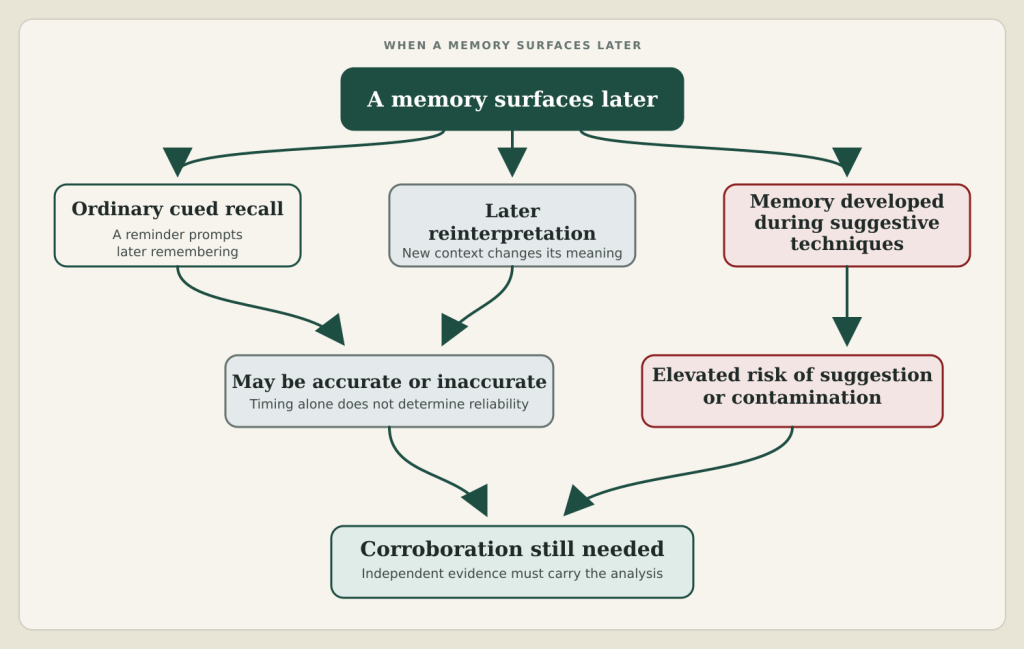
A responsible position refuses both extremes. A newly surfaced memory should not be dismissed simply because it arrived late—but it should not be accepted as historically precise simply because it feels overwhelming. The question is never whether the memory feels real; almost all memories do. The question is what independent evidence can stand beside it.
Trauma-Informed Does Not Mean Uncritical
Trauma-informed interviewing is sometimes misread as agreeing to believe everything. In practice it means the opposite of carelessness: gathering information in a way that reduces needless distress and protects the integrity of the evidence. That includes letting a person speak without interruption, opening with broad rather than leading questions, recording uncertainty in the witness’s own words, avoiding repeated or suggestive questions, and refusing to treat visible emotion—or its absence—as a measure of truth. It also means accepting that “I don’t know,” “I’m not sure,” and “I don’t remember” are legitimate, informative answers rather than failures to be corrected.
The rest is ordinary investigative discipline. Preserve the earliest account. Compare later statements carefully, and document changes rather than explaining them away in advance. Test the account against physical evidence, digital records, messages, medical documentation, other witnesses, and any other independent facts available. No single category of evidence should be interpreted in isolation.
Two Ways to Fail a Survivor
Everything above resolves into a single, uncomfortable shape: there are two opposite errors, and the justice system commits both.
The first is the old one—reading any inconsistency, any gap, any out-of-order account as proof that a person is lying. It is cruel, and it is simply wrong about how memory works. It throws away truthful accounts for failing to arrive in tidy sequence, and it retraumatizes people in the process.
The opposite error can wear a kinder face—treating trauma as a master key that authenticates any memory and explains away every discrepancy. If fragmentation is treated as proof of trauma, and trauma as proof of the account, then the reasoning becomes circular: no inconsistency can be meaningfully examined and no memory can be questioned. That may feel protective, but it replaces investigation with assumption and risks producing an unjust outcome. When that reasoning contributes to a false conviction, it creates further victims: the innocent person imprisoned and—when a crime did occur—the survivor denied an accurate resolution, while the actual perpetrator may remain free.
The deeper trouble is that both errors share one flaw. Each treats memory as a truth-detector—one by reading inconsistency as a lie, the other by reading vividness as a fact. The rigorous position refuses both readings at once. It takes a survivor seriously enough to investigate without flinching, and it respects memory enough never to manufacture a certainty that memory was never built to provide.
Why It Matters
Getting this wrong produces injustice in more than one direction, and both directions have names and faces. When investigators demand a perfectly linear account, they discard truthful people whose memories are incomplete or scrambled. When prosecutors offer trauma as the explanation for every contradiction, they ask jurors to accept psychological language in the place of proof. And when the public treats confidence or raw emotions as evidence, it confuses sincerity with accuracy—the very confusion that has helped make mistaken eyewitness identification one of the leading contributors to wrongful convictions later overturned by DNA.
The better approach is narrower and more honest than either extreme. Trauma can shape attention, memory, disclosure, and behavior. It can explain why a person remembers some things and not others, why an account develops over time, why speaking about the event is so hard. What it cannot do is tell us, by itself, whether a specific allegation is true. Memory evidence deserves the same handling as any other kind: collected properly, guarded against contamination, read in context, and tested against independent facts.
Final Thoughts
Memory is not a videotape, and trauma is not a truth serum. Held together, those two sentences are most of what the justice system needs—and most of what it resists.
What trauma can explain is real, and taking it seriously is an act of fairness: the missing hour, the scrambled order, the one detail seared in while everything around it went dark, the account that surfaces in pieces instead of in sequence. A survivor whose story looks like that should not automatically fail a test of credibility. What trauma cannot do is certify. It cannot turn a vivid memory into a verified one, or a survivor’s certainty into proof. A person does not need a flawless memory to deserve to be heard—and a serious allegation does not become exempt from scrutiny because trauma is involved. Both of those things are true at the same time.
The blade she remembers may be real, and her description may be accurate. Her memory of it may also be a sincere but imperfect reconstruction. What we owe her—and anyone who might be accused—is the discipline to investigate, corroborate, and resist the comfort of pretending memory alone has already given us the answer.
Leave a Reply