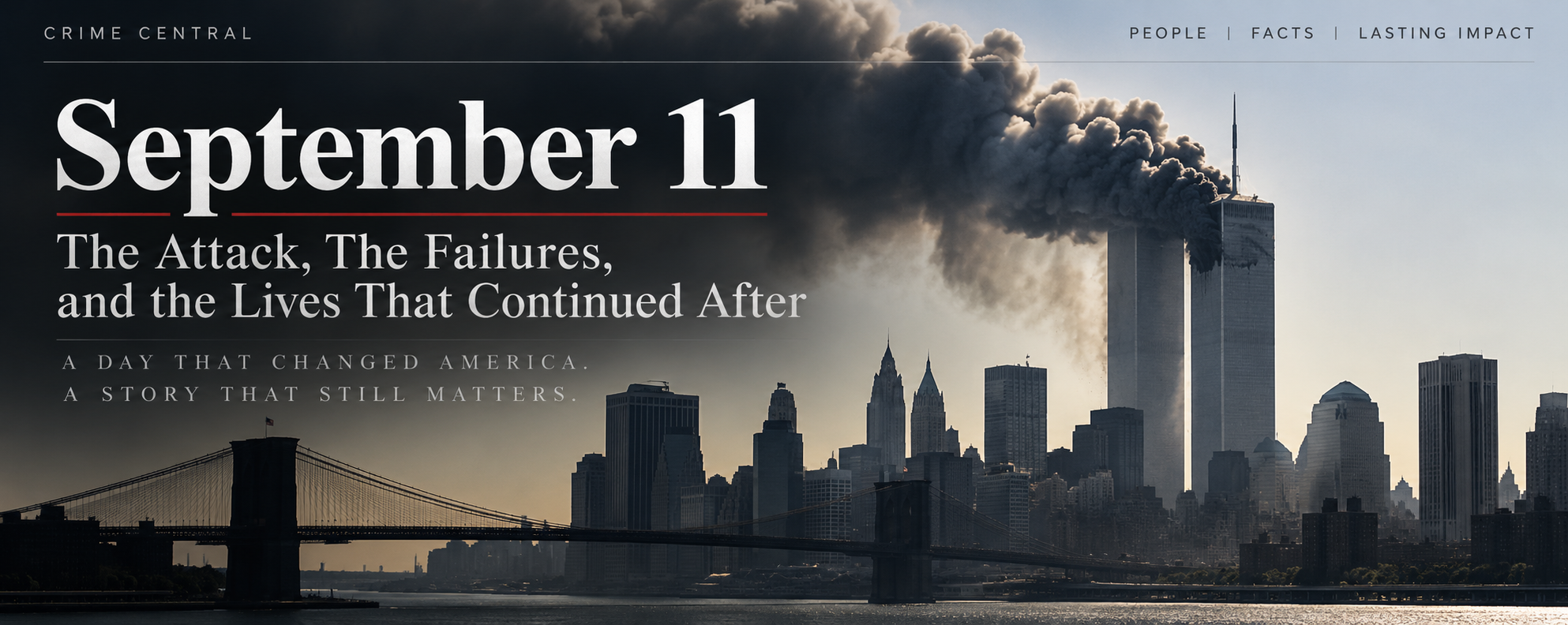
Nearly twenty-five years after September 11, 2001, the attacks are often remembered through the same images: smoke pouring from the World Trade Center, people running through ash-covered streets, a burning section of the Pentagon, and an empty field in Pennsylvania. Those images matter, but they can also flatten a human tragedy into a familiar national symbol. The history of 9/11 is not only the story of what happened that morning. It is also the story of 2,977 individual lives, the people who tried to save them, the warnings institutions failed to connect, and the consequences that continue long after the cameras left.
An Ordinary Tuesday Morning
September 11, 2001, began as an ordinary Tuesday. People boarded early flights, arrived at work, dropped children off at school, and moved through morning routines that gave no warning of what was coming.
Nineteen members of al-Qaeda hijacked four commercial airplanes. At 8:46 a.m., American Airlines Flight 11 struck the North Tower of the World Trade Center. At first, many people—including some inside the South Tower—believed a terrible accident had occurred. That interpretation ended at 9:03 a.m. when United Airlines Flight 175 hit the South Tower.
At 9:37 a.m., American Airlines Flight 77 struck the Pentagon. United Airlines Flight 93, whose passengers and crew learned about the other attacks through calls from the plane, crashed near Shanksville, Pennsylvania, at 10:03 a.m., after they attempted to regain control of the aircraft. Investigators concluded the hijackers likely intended to strike the U.S. Capitol or the White House.
The South Tower collapsed at 9:59 a.m. The North Tower followed at 10:28 a.m. In less than two hours, the physical landscape of lower Manhattan had changed, the Pentagon had been attacked, and four passenger planes had been destroyed.
The attacks killed 2,977 people, not including the 19 hijackers. The dead included passengers and crew members, office workers, contractors, visitors, military and civilian Pentagon employees, and 441 first responders. Thousands of other people were injured, while families across the world spent hours calling hospitals, hotlines, and one another in search of information that often did not come.
The number 2,977 is necessary for understanding the scale of the crime, but it is not a complete account of the loss. Each person had a history that began before that morning: relationships, habits, unfinished plans, ordinary frustrations, and people expecting them to return home. Remembering the attacks responsibly requires resisting the ease with which a death toll can turn people into a single collective symbol.
The Choices Made Inside the Towers
The evacuation of the World Trade Center was shaped by urgency, confusion, and incomplete information. After the North Tower was hit, an announcement in the South Tower told occupants that the building was secure and that they could return to or remain in their offices. Some obeyed; others continued to evacuate the building. When Flight 175 struck the South Tower 17 minutes later, those decisions became a matter of survival.
This is not a reason to judge the people who stayed. They were responding to the information available to them from an authority they had every reason to trust. In emergencies, hindsight can make uncertain decisions appear obvious. They were not obvious to the people making them in real time.
First responders entered the towers while thousands of people were still trying to leave. Firefighters climbed upward carrying equipment as office workers descended. Police officers, emergency medical workers, building employees, and civilians helped direct people toward exits. Some carried injured strangers while others stayed with people who could not move quickly enough on their own.
Stories of courage are central to the memory of 9/11, but courage should not be used to make the deaths seem inevitable or uncomplicated. Many responders entered without reliable information about the buildings’ condition. Radio failures and incompatible communication systems made it difficult for warnings and evacuation orders to reach everyone. The heroism of individuals existed alongside failures in preparation, communication, and command.
From Rescue Sites to Crime Scenes
The first response was rescue. At the World Trade Center, the Pentagon, and the field near Shanksville, responders searched for survivors while fires burned and debris remained unstable. As the likelihood of finding survivors diminished, the sites also became crime scenes of unprecedented size.
The FBI called its investigation PENTTBOM, short for Pennsylvania, Pentagon and Twin Towers Bombing. It became the largest investigation in the Bureau’s history. At its peak, more than half of all FBI agents were working with partner agencies to identify the hijackers, trace their movements, determine who supported them, and prevent another attack. Investigators followed more than half a million leads.
The evidence was scattered across multiple states and countries. It included passenger records, airport surveillance, financial transactions, phone records, vehicles, luggage, flight-school histories, and fragments recovered from the crash sites. Within hours, investigators began identifying the 19 hijackers. The evidence ultimately established that al-Qaeda, led by Osama bin Laden, planned and carried out the attacks.
Identifying the perpetrators, however, answered only one part of the public’s question. Another remained: how had a plot involving 19 men, four airplanes and years of preparation gone undetected long enough to succeed?
The Warnings That Did Not Become Prevention
The 9/11 Commission was created in 2002 to provide a complete account of the attacks and recommend reforms. Its investigation did not uncover one single warning that clearly described the full plot and was ignored. What it found was more complicated—and, in some ways, more troubling.
Before the attacks, agencies possessed separate pieces of information about al-Qaeda, known extremists, aviation threats, and suspicious activity. The intelligence community was aware that al-Qaeda intended to strike the United States. A presidential daily brief delivered on August 6, 2001, was titled “Bin Ladin Determined to Strike in US.” Yet agencies did not assemble the available information into a picture specific enough to disrupt the plot.
Two future hijackers, Khalid al-Mihdhar and Nawaf al-Hazmi, had been connected to a January 2000 al-Qaeda meeting in Malaysia. They later entered the United States. Information about them was not shared effectively or added to watchlists in time. Separately, an FBI agent in Phoenix warned about the possibility that Osama bin Laden was coordinating the attendance of extremists at American aviation schools. In Minnesota, agents arrested Zacarias Moussaoui in August 2001 after a flight school became suspicious of his interest in learning to fly a commercial aircraft without learning to take off or land. Those events were not connected before September 11.
The Commission described failures of imagination, policy, capabilities and management. Bureaucratic barriers restricted information sharing. Counterterrorism responsibilities were divided among agencies whose priorities, technologies and legal authorities did not align. Aviation security was designed largely around the threat of traditional hijacking, in which passengers were held hostage—not aircraft used as weapons.
That distinction matters. Saying that agencies “should have known” can imply that the entire plan was visible in advance. It was not. But the absence of a complete blueprint does not erase the institutional failures that prevented fragments from being analyzed and acted upon together. Accountability lies not only in whether one person could have predicted the exact attack, but in whether systems were capable of recognizing and responding to a growing threat.
The Air at Ground Zero
In the days after the attacks, public attention focused on rescue and recovery. Less visible was the danger carried in the dust.
The collapse of the towers released a dense mixture of pulverized concrete, glass fibers, metals, asbestos, combustion products, and other contaminants. Responders, cleanup workers, residents, students, and people who worked in Lower Manhattan breathed the air and carried dust on their clothing. Some had inadequate respiratory protection. Others received public assurances that environmental testing showed the air posed little immediate danger—assurances later heavily criticized for understating uncertainty and exposure risks.
Over time, many developed respiratory illnesses, digestive disorders, cancers and mental-health conditions. Post-traumatic stress disorder and depression have proven especially persistent, and research drawing on the World Trade Center Health Registry has found suicide rates among responders significantly higher than in the general population, with the risk sharply greater among those living with PTSD. It is one reason the World Trade Center Health Program treats mental-health conditions alongside physical ones. The health consequences did not remain confined to the people who arrived on September 11. They also affected construction workers, sanitation workers, volunteers, nearby residents and students, including people who had been children in 2001.
The James Zadroga 9/11 Health and Compensation Act created a federal framework for monitoring and treating eligible responders and survivors. Today, the World Trade Center Health Program covers qualifying physical and mental health conditions and supports continuing research. The September 11th Victim Compensation Fund provides compensation for eligible physical harm or death connected to the attacks and their aftermath.
These programs exist because the victim count did not stop on September 11. People have continued to become sick and die from exposure-related conditions. Their experiences complicate the common idea that the “aftermath” began once the attacks ended. For many families, it lasted years before a diagnosis and continues through treatment, disability, financial strain, and grief.
Security, Surveillance and the Expansion of Government Power
September 11 reshaped American law and government with extraordinary speed. Congress passed the USA PATRIOT Act in October 2001, expanding federal investigative and surveillance powers. The Transportation Security Administration was created, airport screening changed, and cockpit doors were reinforced. In 2002, Congress established the Department of Homeland Security, bringing 22 federal departments and agencies into a new cabinet-level department. Intelligence-sharing systems were reorganized, and the position of Director of National Intelligence was later created.
Some reforms addressed weaknesses exposed by the attacks. Better information sharing, stronger aviation security, and clearer emergency planning were not abstract policy goals; they were responses to documented failures that had cost lives.
But fear also created conditions in which broad government powers could expand with limited public debate. Surveillance, detention, immigration enforcement and watchlisting practices raised lasting questions about privacy, due process and discrimination. The United States launched wars in Afghanistan and Iraq, although Iraq was not responsible for the September 11 attacks. Policies justified within the broader “war on terror” included indefinite detention and torture, leaving legal and moral consequences that extended far beyond the original crime.
Security and civil liberties are often presented as opposites, as if protecting one requires surrendering the other. The history after 9/11 shows why that framing is dangerous. Government has a responsibility to prevent violence. It also has a responsibility to ensure that fear does not make constitutional protections conditional.
The Backlash Against People Who Had Nothing to Do With the Attacks
The attacks were carried out by 19 members of al-Qaeda. Responsibility belonged to them, their organization, and those who knowingly helped the plot. It did not belong to Muslim, Arab, Sikh, or South Asian communities.
Yet people from those communities—and people merely perceived to belong to them—faced violence, threats, vandalism, employment discrimination and harassment after September 11. Sikh Americans were among those targeted because attackers incorrectly assumed turbans signified a connection to terrorism. The Justice Department investigated hundreds of backlash incidents in the years after the attacks and brought federal prosecutions in dozens of cases.
This violence should not be treated as an unrelated footnote. It was part of the social aftermath of 9/11: grief and fear redirected toward innocent people. Honoring victims of terrorism cannot require creating new victims through collective blame.
Memory Without Mythmaking
Public memory often compresses 9/11 into a handful of phrases, such as “Never forget.” “United we stand.” “The day everything changed.” Each reflects something real, but none is sufficient on its own.
To remember only national unity can obscure who was excluded from it. To remember only individual heroism can hide institutional failures. To focus only on the spectacle of the collapsing towers can turn victims’ deaths into endlessly replayed imagery. And to treat every policy adopted afterward as an unavoidable response prevents meaningful examination of what the country did in the victims’ names.
A victim-centered history begins with the people killed, but it does not end there. It includes the relatives who fought for an independent commission, responders who demanded health care, survivors who carried trauma into ordinary life, and targeted communities forced to defend their belonging while they were grieving too. It makes room for courage without using courage to excuse preventable failures. It acknowledges genuine security needs without declaring every response justified.
The attacks changed the world, but “change” is not a moral judgment. Some changes made aviation and intelligence systems safer. Others expanded state power, enabled abuse or deepened suspicion toward entire communities. Remembering responsibly means being willing to examine both.
Where the Story Stands Today
Osama bin Laden was killed by U.S. forces in Pakistan in 2011.
The man accused of designing the plot he ordered is still awaiting trial.
Khalid Sheikh Mohammed—identified by investigators as the principal architect of the attacks—was captured in Pakistan in 2003 and held in secret CIA custody before his transfer to Guantánamo Bay in 2006. He and his co-defendants have remained in military-commission proceedings ever since. The length and complexity of those proceedings have frustrated many victims’ relatives and raised continuing questions about torture-tainted evidence, due process, and whether the military commission system can deliver a credible resolution.
Those questions are not abstract. Before he was charged with anything, Mohammed was waterboarded 183 times, a figure documented by the Senate’s own investigation of the interrogation program. A fifth defendant, Ramzi bin al-Shibh, was severed from the case in 2023 after a judge found him mentally incompetent to stand trial. His attorneys and medical experts have linked his severe psychiatric symptoms to abuse he experienced while in U.S. custody.
Much of the two decades of pretrial litigation has turned on a single unresolved problem: what evidence a court can use when so much of it is entangled with coercion.
The torture did not only raise a moral question. It created a legal one, and that legal question is a central reason the case has never reached a verdict.
In 2024, prosecutors negotiated plea agreements with Mohammed and two co-defendants: guilty pleas and life without the possibility of parole, in exchange for the government’s taking the death penalty off the table—and, for families, the possibility of answers only these men could provide. Two days after the deals were announced, then-Defense Secretary Lloyd Austin revoked them. A military judge ruled he lacked the authority to undo agreements already signed and reinstated them; the Justice Department appealed. In 2025, a divided federal appeals court sided with Austin, threw out the plea deals and restored the possibility of capital trials. The Supreme Court is weighing whether to review that decision.
The families were never united on any of it. Some had wanted the certainty and the answers a plea would bring; others were unwilling to see the death penalty abandoned and insisted on the full trial they believed the dead were owed. Both groups had waited more than two decades. The process managed to disappoint all of them at once.
In August 2026, a military judge set a new trial date of June 5, 2028—roughly 18 months later than prosecutors had requested—because the court still needs time to determine which evidence may be presented. If that date holds, the trial will begin nearly twenty years after the defendants were first arraigned and almost twenty-seven years after the attacks. A trial was scheduled once before, for 2021, and it never happened.
The evidentiary problems are still unfolding. Days after setting the 2028 trial date, the military judge suppressed statements Mohammed made to FBI agents at Guantánamo in 2007, ruling that they had not been given voluntarily. The decision underscored a problem that has followed the prosecution for years: even evidence gathered after Mohammed left CIA custody can become entangled with the coercion and torture that preceded it.
Meanwhile, the consequences of exposure continue. The World Trade Center Health Program still monitors and treats responders and survivors, and research continues to identify how 9/11-related conditions develop over time. The names of the 2,977 people killed are inscribed at memorials in New York, at the Pentagon and near Shanksville, but remembrance is also carried privately—in families, workplaces and communities permanently shaped by who did not come home.
September 11 should be remembered as an act of mass murder and terrorism. It should also be studied as a failure of systems, a test of democratic values and an unfinished public-health crisis. The most honest promise to “never forget” is not simply to repeat what happened. It is to remember the people as people, examine what failed without simplifying it, and remain accountable for what was done afterward.
Leave a Reply